
























Lezione 24 · Academic Vocabulary
A system for learning academic vocabulary
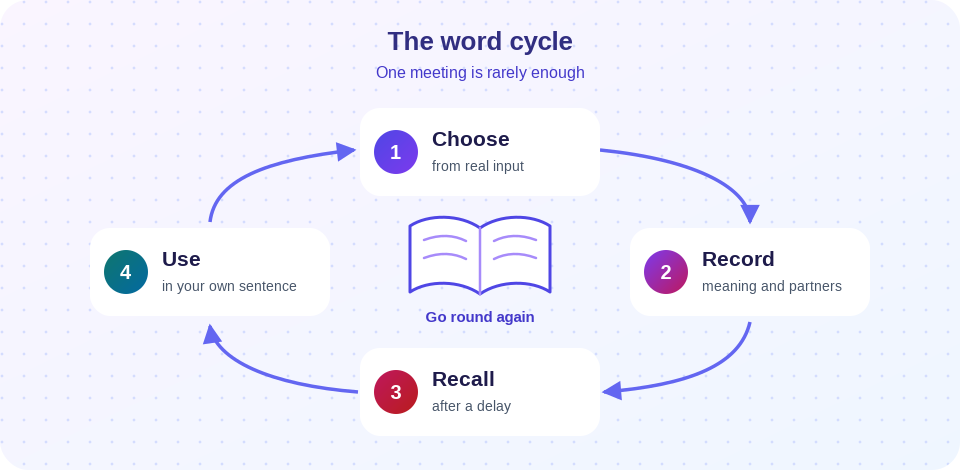
Learn academic English words that stay in memory: choose useful words, record them with partners and examples, review on a schedule, and use them.
Vocabulary helps in every part of the test. It affects how fast you read, how much of a talk you catch, and how precisely you speak and write. But memorizing a long list of translations rarely lasts. You need a small system that you can repeat every week.
This tutorial is independent, and no word list here comes from a real test. Nobody outside the test owner knows which words will appear.
What you will learn
- Which words deserve your time
- What to write on a word record
- How to space your reviews
- How to move a word from "I recognize it" to "I can use it"
Know a word deeply
The weekly cycle
Which words to choose
It helps to sort words into three groups.
| Group | Examples | What to do |
|---|---|---|
| Everyday words | book, walk, happy | Learn only the ones you still miss. |
| General academic words | analyze, factor, significant, assume | Give these the most time. |
| Subject words | enzyme, tariff, sediment | Understand them when a text explains them. |
General academic words appear in many subjects, so each one repays your effort many times. Subject words are often explained inside the passage or talk.
Choose a word if you met it in real reading or listening, it appeared more than once, or you wanted it while writing and did not have it.
The word record
A useful record has more than a translation.
| Field | Example |
|---|---|
| Word and type | assume (verb) |
| Meaning here | to accept something as true without proof |
| Partners | assume that ...; it is safe to assume; assume responsibility |
| Family | assumption (noun) |
| Source sentence | The model assumes that prices stay the same. |
| My sentence | I assumed the class was online, so I stayed home. |
Notice that assume responsibility uses a different meaning: to take on a duty. Record a second meaning only when you meet it.
Say the word aloud with the correct stress. A reliable learner's dictionary shows stress, often with a small mark before the strong syllable.
Guess before you check
When you meet a new word, look for clues first.
- Definition clue: The soil was arid, that is, very dry.
- Contrast clue: Unlike her talkative brother, Lena was reserved.
- Example clue: Nocturnal animals, such as owls and many bats, are active after dark.
- Result clue: The evidence was so flimsy that nobody believed the claim.
Guess, then confirm in a dictionary. The effort of guessing makes the answer easier to notice.
Space your reviews
Trying to recall an answer usually helps memory more than reading it again. Spreading reviews over time also tends to work better than doing them all at once. A simple pattern is:
- Review the next day.
- Review about three days later.
- Review a week later.
- Review a few weeks later.
If you forget a word, move it back to the start. The pattern is a practical guide, not a law.
Test yourself in both directions: from the word to the meaning, and from the meaning to the word. The second direction is harder, and it is what you need for speaking and writing.
Make the word active
Within a day of learning a word, do at least one of these:
- write a true sentence about your own life
- use it in a discussion post
- say it while you explain an article aloud
- swap a vague word such as "good" or "thing" in an old answer
A weekly plan
| Day | Job | Time |
|---|---|---|
| Monday | Pick 8 to 10 words from your reading | 20 minutes |
| Tuesday | Recall them, then write sentences | 10 minutes |
| Thursday | Recall again, add partners | 10 minutes |
| Sunday | Write one paragraph using five of them | 15 minutes |
The number of words is only a suggestion. Choose a pace that you can keep.
Common mistakes
Avoid collecting hundreds of words that you never review. Avoid choosing rare words to sound impressive. A common word used correctly is better than a difficult word used wrongly.
Try it
Think of the meaning before you flip. Say your own example aloud.
Check your understanding
Quick check · 4 questions
of 4 answered You scored / 4 · perfect!
-
1. Which words usually deserve the most study time?
They return across many topics. -
2. Why test yourself from meaning to word?
Producing a word is harder than recognizing it. -
3. In the sentence The soil was arid, that is, very dry, which clue helps?
The phrase that is introduces a definition. -
4. What should happen when you forget a word at a review?
A forgotten word needs shorter gaps again.
Summary
- Focus on general academic words that you meet in real input.
- Record meaning, partners, family, and examples.
- Recall after delays instead of only rereading.
- Use new words soon in speech and writing.
Tieni traccia dei progressi
Crea un account gratuito per segnare le lezioni completate e riprendere da dove avevi lasciato su qualsiasi dispositivo.