
























Lezione 1 · Getting Started
Piano and Keyboard: Course Map
See how this beginner piano and keyboard course works: nine chapters from posture and key names to reading music, chords, pedaling and practice plans.
Welcome. This course takes you from your very first key press to playing short pieces with both hands. It works for an acoustic piano, a digital piano or an electronic keyboard. You do not need any experience, and you do not need to read music yet.
Learning an instrument is a physical skill and a reading skill at the same time. Your hands learn by slow, repeated movement. Your eyes and ears learn by small daily tasks. This course gives you both, in a clear order.
What you will learn
- How the nine chapters fit together
- What you need before you start
- How to use each lesson and its exercises
- How to practice in short, useful sessions
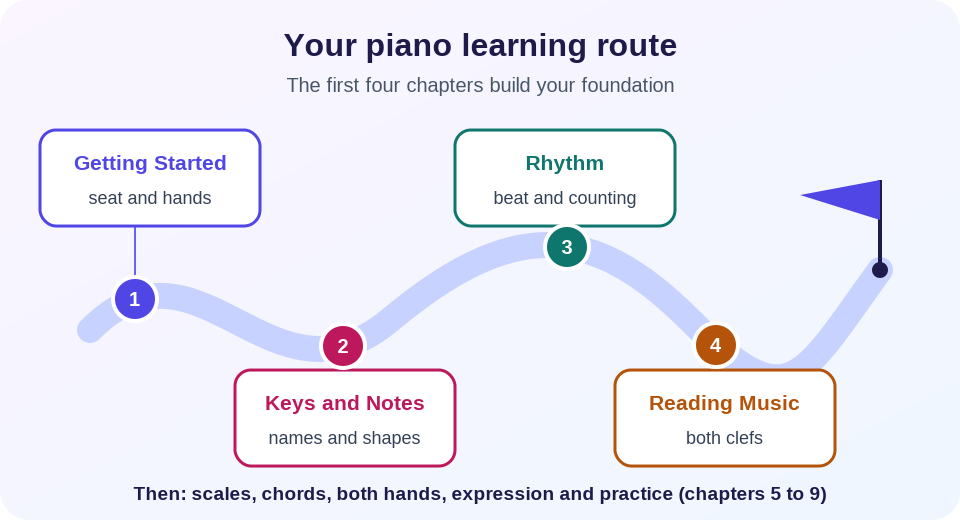
The nine chapters
| Chapter | What you can do after it |
|---|---|
| 1. Getting Started | Choose an instrument, sit well and shape your hands |
| 2. The Keyboard and Notes | Name any key and play a simple five-finger pattern |
| 3. Rhythm | Count beats and play note values and rests in time |
| 4. Reading Music | Read notes in the treble and bass clefs |
| 5. Scales and Technique | Play scales with a steady hand and good fingering |
| 6. Chords and Harmony | Build common chords and use them to support a melody |
| 7. Both Hands Together | Coordinate two different parts |
| 8. Expression and Playing Pieces | Shape loudness, touch and pedal, and learn a whole piece |
| 9. Practice and Review | Plan your practice and check what you know |
Take the chapters in order the first time. Each one uses ideas from the one before it. For example, you will count rhythms in chapter 3 before you read them together with pitches in chapter 4.
What you need
You need three things:
- An instrument with piano-style keys. The next lesson helps you choose one. If you already own a small keyboard, you can start today.
- A stable seat. A bench or a chair without arms is a good choice.
- A little regular time. Short sessions on most days usually work better than one very long session each week.
Some extras help but are not required: a metronome (many keyboards and free apps have one), a pencil for marking your music and headphones if your instrument supports them.
How to use each lesson
Every lesson has the same shape. First, you read a short explanation with worked examples. Then you check the common mistakes. After that, you use an interactive exercise on the page. Last, you answer a short quiz.
The on-page exercises are silent. They train your eyes, memory and counting. You still need to play on your real instrument, because only your hands can learn the movements.
Keep a small practice notebook. After each session, write one thing that improved and one thing to work on next time. This takes one minute and makes your next session easier to start.
A simple first practice routine
Here is a routine you can use during chapters 1 to 4. It takes about 15 to 20 minutes.
| Time | Activity |
|---|---|
| 2 minutes | Check your seat, shoulders and hands |
| 5 minutes | Play something you already know, slowly |
| 8 minutes | Work on the new idea from today's lesson |
| 3 minutes | Play freely and enjoy the sound |
If you only have five minutes, that is still useful. Choose one small task, such as finding every C on your instrument.
Playing safely
Playing the piano should not hurt. Stop if you feel pain, tingling or numbness. Rest, and check your posture and tension when you return. If the problem continues or keeps coming back, talk to a qualified health professional. A good teacher can also watch your movements and spot habits that you cannot see yourself.
Protect your hearing too. Use a comfortable volume, especially with headphones.
Do you need a teacher?
You can learn a lot on your own. A teacher adds something a web page cannot: someone who watches your hands, listens to your playing and gives feedback right away. Even a few lessons can help you check your posture and technique. If that is not possible, record yourself with a phone from the side and watch it later.
How to tell you are ready to move on
You do not need to be perfect before starting the next lesson. Use a simple test. Can you explain the main idea in your own words? Can you do the playing task slowly, without stopping, two or three times? If yes, move on and keep reviewing the old task for a few days. If no, stay a little longer and make the task smaller.
Common mistakes
- Skipping the early chapters because they look easy. Posture and counting habits start now.
- Practicing fast before practicing correctly. Speed copies your mistakes too.
- Waiting for a free hour. Ten focused minutes today is better than a plan for later.
- Playing through pain. Pain is a signal to stop.
Try it
Use this planner to build your first week. Choose your days and minutes, and it shows your total.
Check your understanding
Quick check · 4 questions
of 4 answered You scored / 4 · perfect!
-
1. Why should you take the chapters in order the first time?
The course builds step by step, so earlier ideas support later ones. -
2. What can the silent exercises on this site NOT do for you?
Physical movement is learned by playing a real instrument. -
3. What should you do if you feel pain or numbness while playing?
Playing should not hurt. Pain, tingling or numbness mean you should stop. -
4. Which practice habit is usually more useful for a beginner?
Regular short sessions give your memory and hands frequent practice.
Summary
- The course has nine chapters that build on each other.
- You need a keyboard instrument, a stable seat and regular time.
- Each lesson has explanations, common mistakes, an exercise and a quiz.
- The exercises on the page support, but do not replace, real playing.
- Stop if something hurts, and keep your volume comfortable.
Tieni traccia dei progressi
Crea un account gratuito per segnare le lezioni completate e riprendere da dove avevi lasciato su qualsiasi dispositivo.