
























Lezione 6 · Listening Strategies
Before you listen: prepare and predict
Get ready before you listen in English: set a purpose, predict content and words, study the questions, and plan what to do on a first and second listening.
Good listening starts before the first word. A minute of preparation gives your brain a frame, so that new information has somewhere to go.
This chapter follows one cycle: prepare, listen, check. This lesson is about preparing. The next ones show different ways of listening.
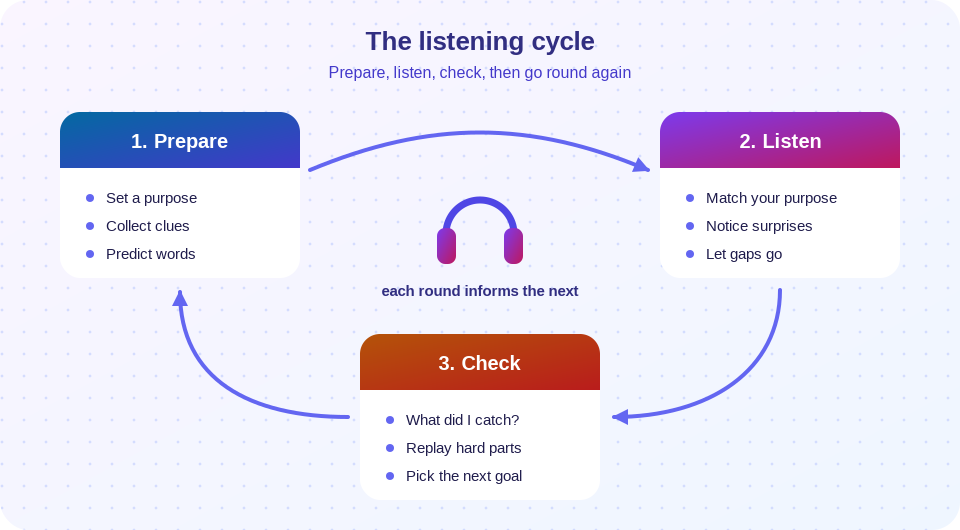
What you will learn
- How to set a clear listening purpose
- How to predict ideas and words
- How to prepare when you have questions in advance
- How to plan more than one listening
Before
During
After
Start with a purpose
In daily life you usually have a reason to listen. You want a platform number, a friend's opinion, or the steps for fixing something. Your reason decides how to listen.
| Your reason | What you need | Way of listening |
|---|---|---|
| Is this video worth watching? | The general topic and point | Gist |
| When does my bus leave? | One piece of information | Specific information |
| How do I set up this device? | Every step, in order | Detail |
| Is my friend really happy about it? | Feeling and hidden meaning | Inference |
When you practice with a recording, give yourself a purpose too. "Listen to this" is vague. "Find out why the event moved" is clear.
Gather clues
Before you press play, collect what you already have.
- The title and any short description
- The speaker: who they are, if you know
- The setting: a station, a classroom, a phone call
- Pictures or slides that come with the recording
- The length, which tells you how much detail to expect
Predict ideas and words
Turn your clues into guesses. Imagine a recorded message from a dentist's office about a changed appointment. You might predict:
- Who and why: a staff member, with news about your visit
- Likely information: a name, an old time, a new time, a phone number
- Likely words: appointment, reschedule, available, confirm, call back
Say the likely words in your head, with their sounds. Then they are easier to notice. If you do not know how to say one, check a dictionary with audio.
Predictions are not answers. The message may be about a bill instead. Hold your guesses loosely and drop any that the recording does not support.
When you have questions first
In classes and tests, you may see questions before you listen. Use that time well.
- Read each question and find the question word: who, when, why, how much.
- Decide the type of answer: a name, a number, a reason, an opinion.
- Mark key words, then think of other ways to say them. The speaker may use different words. A question about the "cost" may be answered with "you pay" or "the fee is".
- Notice the order. Check the instructions to see whether the questions follow the recording. Do not assume it.
- Notice limits, such as a maximum number of words.
Here is a worked example.
| Question | Answer type | Words the speaker might use |
|---|---|---|
| Why was the picnic moved? | A reason | because, due to, so, since |
| Where will it be now? | A place | instead, move to, meet at |
| What should people bring? | One or more things | take, do not forget, you will need |
Plan your listenings
With a recording that you can replay, give each listening a job.
| Listening | Job |
|---|---|
| First | Topic, speakers and main point |
| Second | The details that answer your purpose |
| Third (study only) | The parts that were hard, then with a transcript |
Real life often gives you one chance. So practice both ways. Sometimes play a clip only once and see what you can report. At other times, replay as often as you like and study the hard parts closely.
A worked preparation
Here is one minute of preparation by a learner called Joon. The recording is called "Volunteering at the weekend food market". The description says that an organizer is speaking to new helpers.
| Step | Joon's notes |
|---|---|
| Purpose | Find out what a new helper has to do |
| Speaker and listeners | An organizer talking to new people, so probably welcome and instructions |
| Likely topics | Arrival time, jobs, clothes, safety |
| Likely words | shift, stall, sign in, gloves, supervisor |
| One question | Do helpers need to bring anything? |
During the first listening, Joon notices that the organizer spends a long time on lifting boxes safely. He had predicted safety but not lifting. His preparation still helped, because he had a place to put the new idea. He also predicted "gloves", and the word never came. That does not matter at all. He drops the guess and moves on.
Afterward he asks himself two things: Did I serve my purpose? Which useful word did I fail to predict or recognize? He adds that word, with its sound, to his list.
Common mistakes
Pressing play with no purpose. You may try to catch everything and keep nothing. Falling in love with a prediction. Listen for what is really said, even if it surprises you. Reading only the exact words in a question. Think about other ways to express the same idea.
Try it
For each situation, choose the best preparation.
Use the cards to practice predicting. For each one, say several likely words aloud before you turn it over.
Check your understanding
Quick check · 4 questions
of 4 answered You scored / 4 · perfect!
-
1. Why is it useful to set a purpose?
A purpose guides your attention and your way of listening. -
2. What should you do with a prediction that the recording does not support?
Predictions are guesses that you test. -
3. Why think of other ways to say the words in a question?
The recording often uses different words from the question. -
4. What is a good job for a first listening to a replayable clip?
The big picture comes first and helps with details later.
Summary
- Prepare with a purpose, because it decides how you listen.
- Use titles, setting and pictures to predict ideas and words.
- With questions in advance, find the answer type and think of other wording.
- Give each listening a job, and practice single-play listening too.
Tieni traccia dei progressi
Crea un account gratuito per segnare le lezioni completate e riprendere da dove avevi lasciato su qualsiasi dispositivo.