
























Lezione 22 · Light and Shading
Shading: How Light Falls on Form
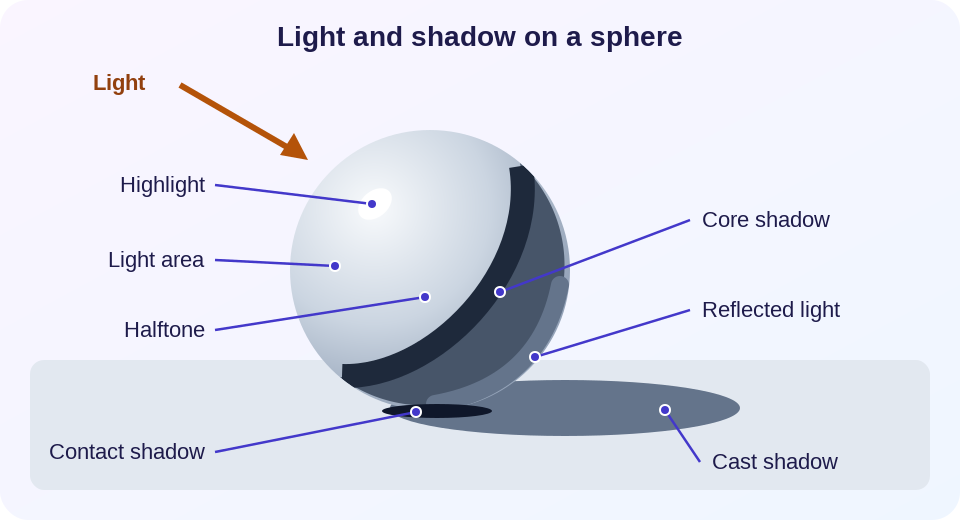
Understand light and shadow for drawing: highlight, halftone, core shadow, reflected light and cast shadow, shown on a sphere with one lamp.
Lines show the edges of things. Shading shows their volume. It tells the viewer which surfaces face the light and which turn away from it.
You do not need to copy every patch of gray you see. If you understand how light behaves, you can look for a few predictable areas and draw them clearly.
What you will learn
- The main idea: surfaces facing the light look lighter
- The named areas of light and shadow
- The difference between a form shadow and a cast shadow
- How the light's direction and size change what you see
The main idea
Think of light as traveling in straight lines from its source. A surface that faces the source squarely gets a lot of light. A surface at a slant gets less, because the same light spreads over more area. A surface that faces away gets no direct light at all.
On a box, the change is sudden: each flat face has its own tone. On a ball, the surface turns gradually, so the tone changes gradually too.
The color or tone of the object also matters. A black ball in strong light can still be darker than a white ball in shadow. The tone that belongs to the object itself is often called its local value.
The areas of light and shadow
Place a plain, matte ball on a table. Use one lamp from the upper left, in a dim room. Then look for these areas.
| Area | Where it is | What it looks like |
|---|---|---|
| Highlight | A small spot on the light side | The brightest reflection of the lamp |
| Light | Surfaces facing the lamp | Light tones |
| Halftone | Surfaces turning away from the lamp | Middle tones |
| Core shadow | Just past the edge of the direct light | A darker band on the form |
| Reflected light | Inside the shadow side, often near the table | A slightly lighter area |
| Cast shadow | On the table, away from the lamp | A shape blocked from direct light |
| Contact shadow | Where the ball almost touches the table | Often very dark |
The line where the direct light stops is called the terminator. On a ball it is a curve that wraps around the form. With a small lamp it is fairly easy to find. With a large, soft light it becomes a wide, gentle change.
A matte object, like unglazed clay or paper, spreads its light softly. A shiny object, like glazed pottery or metal, shows sharp reflections of the room. Learn on matte objects first.
Form shadow and cast shadow
- A form shadow is on the object's own surface, on the side that faces away from the light.
- A cast shadow falls on another surface, because the object blocks the light.
An object can also cast a shadow onto itself. For example, a nose can cast a shadow onto a face, and a cup handle can cast one onto the cup.
Cast shadows often have a sharper edge near the object that makes them. Farther away, the edge usually gets softer, especially with a larger light source. Check this on your own table.
Reflected light: keep it quiet
Light bounces off the table and nearby things and returns into the shadow side. That is reflected light. It is real, and it helps a form look round.
The classic mistake is to make it too bright. If the reflected light looks as pale as the light side, the ball looks flat or glassy. A useful rule for a single strong lamp on a plain object: keep every tone in the shadow side darker than the tones in the light side. White surfaces nearby can bend this rule, so look carefully.
Light direction changes the story
| Light from | Effect |
|---|---|
| The front, near your eyes | Little shadow is visible; forms can look flat |
| The side | Strong sense of volume and texture |
| Above and to one side | A clear, natural look that is good for learning |
| Behind the object | Mostly shadow side, with a bright rim of light |
| Below | An unusual look that can feel strange or dramatic |
For practice, place one lamp above and to the side. Turn off other lights if you safely can. If daylight comes from a window, remember that it changes during the day.
Never look straight at the sun. Keep paper and cloth away from hot lamp bulbs.
Distance and size of the light
A small source, compared with the object and its distance, makes crisp shadow edges. A large source, such as a cloudy sky or a big window, makes soft edges. Moving a lamp closer also makes the lamp larger from the object's point of view, so edges can soften and the light can get brighter.
When you move the lamp higher, a cast shadow on the table gets shorter. When you move it lower, the shadow gets longer.
A worked example
You set a white ball on gray paper with a lamp at the upper left.
- You find the cast shadow on the right and lightly outline its shape.
- You trace the terminator, the curve where the light side ends.
- You shade everything past it, plus the cast shadow, with one flat middle-dark tone.
- You darken the core shadow band and the contact shadow.
- You build halftones gently on the light side, near the terminator.
- You leave a small highlight as bare paper.
Step 3 is the key habit. Splitting the picture into a light family and a shadow family first keeps your drawing clear.
How to look
- Squint. Half-close your eyes. Small details fade and the big light and dark shapes appear.
- Compare. Ask "Which is darker, this or that?" instead of "How dark is this?"
- Name the area. Say "This is the core shadow" to check that your tones make sense.
Common mistakes
Shading from the outline inward on every side. This ignores the light direction.
A bright reflected light. It breaks the shadow side apart.
No cast shadow. The object seems to float.
A gray highlight. Plan ahead and keep that spot of paper clean.
Try it
Move the lamp slider and watch the highlight and the cast shadow change sides. This is a simplified picture, not a physics model.
With a real lamp and an egg or ball, find all the areas in the table above.
Check your understanding
Quick check · 4 questions
of 4 answered You scored / 4 · perfect!
-
1. What is the terminator?
It separates the light side from the form shadow. -
2. Where does a cast shadow appear?
The object stops some light from reaching that surface. An object can also cast one onto itself. -
3. With one strong lamp on a plain matte ball, how should reflected light look?
It is part of the shadow family, so keep it quiet. -
4. What kind of light tends to make soft shadow edges?
Large sources light the edge area from many directions.
Summary
- Surfaces that face the light squarely look lighter than slanted ones.
- Look for highlight, light, halftone, core shadow, reflected light and cast shadow.
- Form shadows sit on the object; cast shadows fall on a surface it blocks.
- Keep the light family and the shadow family clearly apart.
- Light direction and source size change the look.
Next: Values and Value Scales
Tieni traccia dei progressi
Crea un account gratuito per segnare le lezioni completate e riprendere da dove avevi lasciato su qualsiasi dispositivo.