
























Lezione 35 · Practice and Review
Practice Workshop: Real Scenarios
Practice listening, writing, feedback and conflict skills with realistic scenarios, model answers, self-review questions and a small weekly plan.
Reading about communication helps, but skills grow when you use them. This workshop gives you realistic scenes. Think of your own response before you read the model answer.
There is rarely one perfect reply. A model answer is one good option. Your culture, relationship and setting may call for something else.
What you will learn
- How to apply course skills to mixed situations
- How to check your own response
- How to practice safely with others
- How to build a weekly practice plan
A method for any scene
Ask these questions:
- Goal: What do I want to happen?
- Facts: What do I know, and what am I guessing?
- Other side: What might they know, feel or need?
- Channel: Talk, call, message or document?
- Opening: What is my first sentence?
- Check: How will I know we understood each other?
Scene 1: the distracted listener
A friend tells you about a bad day. Your phone keeps buzzing. You notice you are thinking about your own problems.
Model response: Put the phone away. Say, "Sorry, I got distracted. I want to hear this." Then reflect: "So the meeting went badly, and you felt blamed. Is that right?" Ask, "Do you want ideas, or would it help just to talk?"
Skills: attention, reflecting, asking what kind of help is wanted.
Scene 2: the unclear email
You receive: "We need the thing soon. Can you sort it?"
Model response: "Happy to help. Just to confirm: do you mean the updated price list? If so, when do you need it, and who should receive it?"
Skills: clarifying without blame, checking object, deadline and audience.
Scene 3: nervous update
You must give a two-minute update to your team, and part of the project is late.
Model response: Start with the main point: "The website will be ready one week late." Give the cause in one or two sentences, then the plan: "We'll finish the payment page by the 18th. I need one extra tester on Monday." End with "Questions?"
Skills: main point first, short structure, clear request.
Scene 4: feedback for a peer
A teammate's slides have very small text.
Model response: "Would you like a quick comment on the slides? The order of ideas works well. On slides 3 to 5, I couldn't read the labels from the back of the room. Could the text be larger, or the chart split in two?"
Skills: permission, real strength, specific behavior and impact, suggestion.
Scene 5: receiving a sharp comment
In a meeting, a colleague says, "This analysis is useless."
Model response: Pause. "I'd like to make it useful. Which question did it fail to answer?" If the insults continue: "I'm glad to discuss the analysis. Let's keep to specific points." Later, consider a private talk about the wording.
Skills: calm pause, curious question, boundary.
Scene 6: the repeated lateness
A project partner has sent their part late three times.
Model response: "Can we talk about our schedule? Your parts came after the agreed date three times, and I had to finish my section at night. What's getting in the way? What could we change?" Then agree on a new plan and a check date.
Skills: facts, impact, curiosity, agreement.
Scene 7: the cross-cultural meeting
Two new colleagues have not spoken during a fast online discussion.
Model response: "Let's pause for two minutes. Everyone, please add thoughts in the chat or shared notes. We'll collect them before deciding, and you can send more until tomorrow."
Skills: inclusion, writing time, more than one channel.
Review your response
Score yourself from 1 (not yet) to 3 (strong) on each:
| Check | Question |
|---|---|
| Clear | Is my main point or request easy to find? |
| Fair | Did I describe facts, not labels or motives? |
| Open | Did I invite the other view? |
| Respectful | Would this feel respectful to the listener? |
| Actionable | Is the next step clear? |
This score is a personal practice tool, not a scientific measure.
Practice with a partner
- Agree on a safe topic. Do not use a real sensitive conflict at first.
- Take turns: speaker, listener and observer.
- The observer gives one strength and one idea, using situation, behavior and impact.
- Anyone can stop the exercise at any time.
Record only what everyone agrees to record. Rules about recording conversations differ by country and organization.
A small practice plan
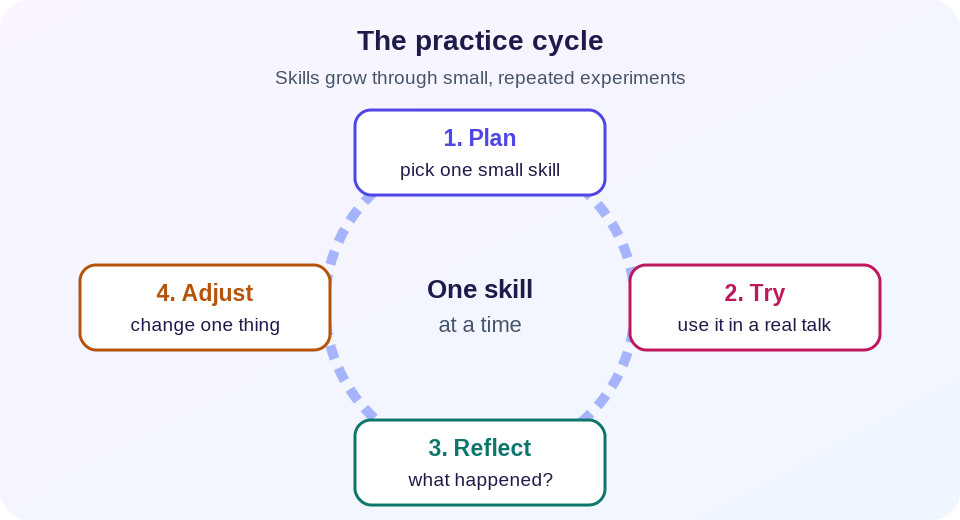
Choose one skill for the week, such as "summarize before I respond."
- Plan: when and with whom will I try it?
- Try: use it in at least a few real conversations.
- Reflect: what happened? What did the other person do?
- Adjust: what will I change next week?
Change one detail
To go further, repeat a scene and change one detail. Imagine the person is your manager instead of a friend, or the talk happens in chat instead of in person. Notice what you would keep and what you would change.
Common mistakes
- Trying to improve every skill at once
- Memorizing model answers word for word
- Practicing with a painful real conflict before you are ready
- Judging yourself harshly after one awkward try
- Skipping reflection after practice
Try it
Read a scene, write your reply, then rate it with the five checks.
Check your understanding
Quick check · 4 questions
of 4 answered You scored / 4 · perfect!
-
1. A message says "Can you sort it?" What is a good first reply?
Clarifying questions prevent wasted work. -
2. In the late-update scene, what should come early?
Listeners need the key fact before the details. -
3. What is a sensible practice goal for one week?
One small, clear skill is easier to practice and review. -
4. What should be true in a partner role-play?
Safety and consent help people learn.
Summary
- Check goal, facts, other side, channel, opening and understanding.
- Model answers are options, not scripts.
- Review replies for clarity, fairness, openness, respect and action.
- Practice one skill at a time with the plan, try, reflect and adjust cycle.
Tieni traccia dei progressi
Crea un account gratuito per segnare le lezioni completate e riprendere da dove avevi lasciato su qualsiasi dispositivo.