
























Pelajaran 32 · Intonation and Accents
Intonation: how pitch carries meaning
Meet the main English tones, falling, rising and fall-rise, see where the pitch moves, and learn how tone can change the feeling of a sentence.
Try saying "Okay" in four ways: as a cheerful yes, as a doubtful question, as a bored reply and as a warning. The sounds stay the same, but the pitch, how high or low your voice goes, changes the message. The pattern of pitch across speech is intonation.
Intonation helps listeners understand whether you have finished, whether you are asking, and how you feel. Its patterns are tendencies, not strict laws, and they differ between accents and speakers.
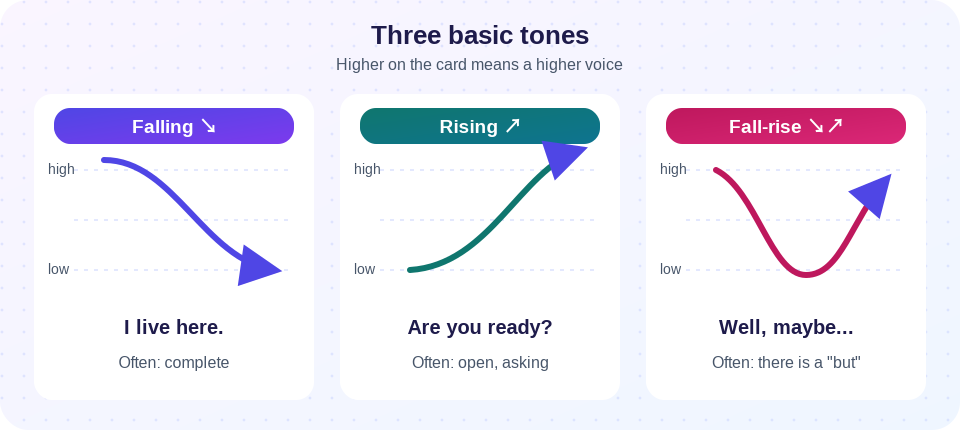
Falling tone
Rising tone
Fall-rise tone
Tendencies, not laws
What you will learn
- Where in a sentence the pitch moves
- What a falling, rising and fall-rise tone often suggest
- How pitch range changes the feeling
- How to practice tones
Where the pitch moves
Remember from sentence stress that each thought group has one main stressed syllable, the nucleus. The important pitch movement usually starts on that syllable. If more syllables follow it, the movement continues over them.
- It's a CAT. (movement on "cat")
- It's a CATegory. (movement begins on "cat" and continues through "egory")
So first choose your focused word. Then choose the tone. If you focus the wrong word, a perfect tone will still point at the wrong place; see focus and contrast.
Falling tone ↘
The pitch moves down. A fall often sounds complete and certain. It is common in:
- statements: "I live near the ↘PARK."
- many wh-questions: "Where do you ↘WORK?"
- commands: "Close the ↘DOOR."
- strong reactions: "That's ↘GREAT!"
A fall that ends very low can sound final. A small or shallow fall can sound flat or tired, depending on the context.
Rising tone ↗
The pitch moves up. A rise often sounds open or unfinished. It is common in:
- many yes/no questions: "Is it ↗FAR?"
- checking what someone said: "You're ↗LEAVing?"
- requests for repetition: "↗WHAT was that?"
- items before the end of a list
A rise on a wh-question can sound gentle and friendly: "What's your ↗NAME?" is often used with children or in friendly service. A rise on a statement can show that you are checking or inviting a reply.
Fall-rise tone ↘↗
The pitch drops and then rises again. It often suggests that there is more to say: doubt, politeness, partial agreement or an unspoken "but".
- "It's ↘↗NICE." (but I'm not sure I want it)
- "I could ↘↗TRY." (I can't promise)
- "Not ↘↗ALL of them." (some of them are)
- "↘↗SOMEtimes I walk." (introduces a topic and keeps going)
With only one syllable, the voice goes down and up on that syllable. With more syllables, it falls on the stressed one and rises at the end.
Pitch range
How far your voice moves also matters. A wide range often sounds interested, surprised or enthusiastic. A narrow range may sound calm, serious, shy, tired or uninterested. People read these clues differently across cultures, so be careful when you guess someone's feelings from their pitch.
For example, say "Thank you very much" with a large fall on "much". Then say it almost flat. The first often sounds warmer. If your own first language uses a narrower range, you may be heard as less friendly than you feel. Practice a little more movement in key places, without turning it into a performance.
Same words, different messages
Look at the reply "I think so" to the question "Is the shop open?"
| Reading | Likely message |
|---|---|
| I ↘THINK so. | This is my honest answer, and I am fairly settled. |
| I ↘↗THINK so. | Probably, but you may want to check. |
| I ↗THINK so? | I am asking you whether I am right, or I am unsure. |
None of these readings is the only possible one. Face, speed and context also send signals. Still, practicing the contrast teaches your voice that it can say more than the dictionary words. Say each line to a mirror and watch your face as well. Many people find that raising their eyebrows slightly helps a rise happen naturally.
When you listen to others, avoid judging from one tone alone. Ask a friendly question if you are not sure what they mean.
Intonation is not tone language
In languages such as Mandarin or Thai, pitch helps to tell apart the meanings of individual words. In English, pitch mainly works at the level of phrases and sentences: it affects focus, attitude and how the conversation is organized. A single English word keeps its dictionary meaning, even when its pitch changes.
How to practice
- Hum the shape: say "mm" with a fall, a rise and a fall-rise.
- Say one word, such as "Really", three times with different tones.
- Add words around it: "That's really ↘GOOD."
- Record yourself on your own device and check whether the pitch actually moved.
Many learners believe they are moving their pitch but are only changing volume. A quick recording shows the difference. This site cannot hear your voice or grade it.
Common mistakes
- Ending every phrase with a rise, which can sound uncertain.
- Putting the movement on the last word even though another word is focused.
- Using a flat pitch for every sentence.
- Treating any tone pattern as a fixed rule for every speaker.
Try it
Check your understanding
Quick check · 4 questions
of 4 answered You scored / 4 · perfect!
-
1. Where does the main pitch movement usually start?
It begins on the main stressed syllable. -
2. Which tone often sounds complete?
A fall usually signals that the point is finished. -
3. What may a fall-rise suggest?
It often implies "but". -
4. How does English differ from a tone language?
English uses pitch mainly across phrases.
Summary
- Intonation is the pattern of pitch in speech.
- Pitch movement usually starts on the nucleus.
- Falls often sound complete, rises open and fall-rises reserved.
- Pitch range affects how feelings sound.
- These are tendencies that vary with context and accent.
Pantau kemajuanmu
Buat akun gratis untuk menandai pelajaran yang selesai dan melanjutkan dari tempat terakhirmu di perangkat mana pun.