
























Pelajaran 9 · Clear Speaking
Structuring a Clear Message
Structure what you say: find your main point, put it first, add only the support the listener needs and use simple patterns for updates, requests and opinions.
Listeners cannot reread your sentence. If they lose the thread, they may not find it again. A clear structure helps them follow, and it helps you stay calm because you know where you are going.
You do not need a script. You need to know your main point, what supports it and what you want to happen.
What you will learn
- How to find your main point before you speak
- Why putting the point first often helps
- Three patterns for updates, requests and opinions
- How to use signposts so listeners can follow
Find the one sentence
Before you speak, finish this sentence: "The one thing I need them to know is..." If you cannot finish it, you are not ready to explain yet. Think about the listener too.
- What do they already know?
- What do they need to decide or do?
- How much time and attention do they have?
The same facts may need a different order for a manager, a new colleague and a customer.
Point first
In many work and study settings, it helps to say the main point at the start: "We need to move the workshop to next week." Then explain why. The listener now knows how to sort each detail you give.
Without that opening, people may spend your whole story wondering, "Where is this going?"
Point first is not a rule for every situation. For sensitive news, you may need a short, kind lead-in. In some cultures and relationships, people expect some context or greeting before a request. Notice what your listener expects. Even then, do not hide the main point for long.
Pattern 1: updates
Use status, issue, next step.
- Status: "The booking page is about two thirds finished."
- Issue: "The payment test is blocked because we don't have access yet."
- Next step: "I've asked for access and I'll check again tomorrow morning."
If there is no issue, say so and keep it short.
Pattern 2: requests
Use ask, reason, details, check.
- Ask: "Could you cover my Friday shift?"
- Reason: "I have an exam that afternoon."
- Details: "It runs from 2 to 8. I can take your Sunday shift."
- Check: "Would that work for you? It's fine to say no."
Be honest about whether the request is optional. If it is not optional, do not pretend that it is.
Pattern 3: opinions
Use point, reason, example, point (often remembered as PREP).
- Point: "I think we should test the form with a few users first."
- Reason: "We may be missing confusing steps."
- Example: "Last month, two people could not find the submit button."
- Point again: "So a short test before launch seems worth it."
Signposts
Signposts are words that tell listeners where you are.
| Purpose | Phrases |
|---|---|
| Preview | "I have two points." |
| Move on | "The second thing is..." |
| Contrast | "On the other hand..." |
| Example | "For instance..." |
| Return | "Going back to the budget..." |
| Close | "So the next step is..." |
A short preview, such as "two points," helps people keep track. Then give exactly what you promised.
Cut what does not help
Detail you enjoyed finding is not always detail your listener needs. Ask, "If I leave this out, will they decide or act differently?" If not, keep it for questions. You can say, "I can explain how we tested it, if that helps."
A longer story can be right when the goal is to teach, entertain or build trust. Match the shape to the goal.
When you are asked a question on the spot, take a breath and say, "Let me think for a moment." Then give your answer first and one reason. A short pause is better than a long ramble.
Worked example
Rambling: "So yesterday I was looking at the printer, and before that the toner guy called, and you know how the old one jams, anyway the invoices..."
Structured: "The invoices will be a day late. The printer on our floor stopped working. I'll use the one downstairs this afternoon and send them by five."
The second version gives the impact first, then the cause, then the plan. Listeners can ask for more if they want it.
Adjust the level of detail
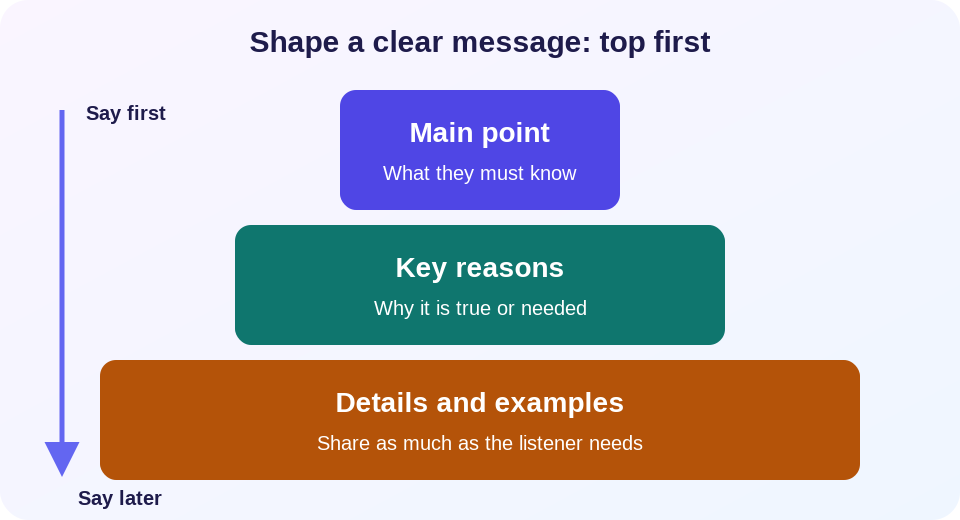
Think of your message in layers. The first layer is one sentence with the point. The second adds the key reasons. The third holds the full detail. Start with the first layer, then watch the listener.
If they say, "Okay, go ahead," you may be done. If they ask why, offer the second layer. If they want to check your work, move to the third.
For example, first layer: "We should keep the current supplier." Second layer: "The new quote is cheaper, but delivery takes longer, and we need parts quickly." Third layer: the actual dates, prices and past orders. This approach protects busy listeners without hiding any information from those who want it.
Close the message
The end of your message is what many people remember. Finish by saying what should happen next, such as a decision, an action or a time to talk again: "Can you tell me by Wednesday which option you prefer?" Then stop talking.
Common mistakes
- Starting with the full history and reaching the point at the very end.
- Packing five main points into one turn.
- Saying "I have two points" and then giving six.
- Ending without a clear request, decision or next step.
- Using the same level of detail for every audience.
Try it
Check your understanding
Quick check · 4 questions
of 4 answered You scored / 4 · perfect!
-
1. What should you know before you start a clear message?
The main point guides everything else. -
2. What are the parts of the update pattern in this lesson?
Status, issue and next step cover what people usually need. -
3. What does PREP stand for here?
It is a simple shape for giving an opinion. -
4. Which is a good test for cutting a detail?
Keep what affects the listener's understanding or action.
Summary
- Know your main point before you speak.
- Put it early in most work and study situations.
- Use status, issue and next step for updates, and PREP for opinions.
- Signposts help listeners follow.
- Cut detail that does not change what people understand or do.
Next: Using Plain Words
Pantau kemajuanmu
Buat akun gratis untuk menandai pelajaran yang selesai dan melanjutkan dari tempat terakhirmu di perangkat mana pun.