
























लेसन 27 · Grammar That Matters
Grammar priorities for the TOEFL test
Find the grammar that matters most for TOEFL tasks, diagnose your own weak points with a short check, and decide what to study first and how.
You do not need to know every grammar rule in English. You need to control the patterns that you use all the time, and to understand longer sentences when you read and listen. The 2026 format has no separate grammar section, but grammar matters inside the tasks: Build a Sentence tests sentence structure directly, and the writing guides and speaking descriptions mention grammar as part of good performance.
What you will learn
- A sensible order for grammar study
- How to find your own weak points
- A study method that moves rules into real use
Build from the base
Study loop
Your own errors set the order
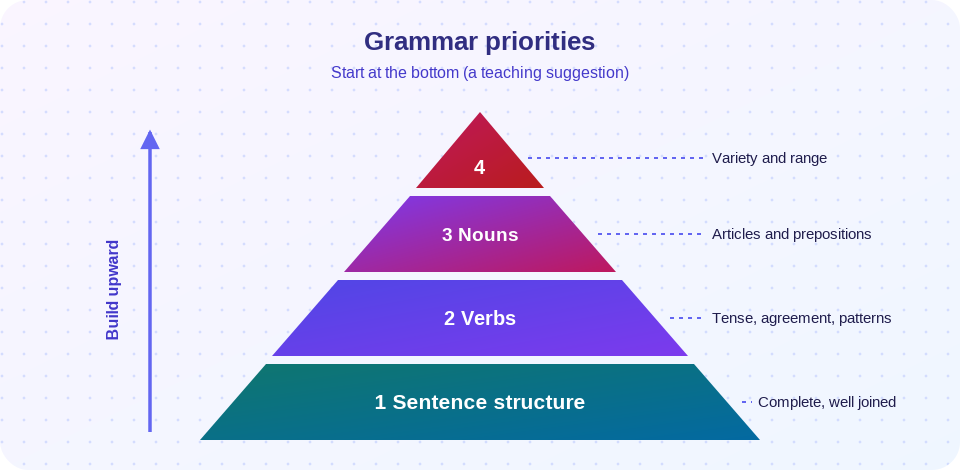
The priority order
This order is our teaching suggestion, based on how strongly each error can damage meaning. It is not an official ranking.
- Sentence structure: each sentence has a subject and a verb, and clauses are joined correctly. See sentence structure and clauses.
- Verbs: tense, agreement, and common verb patterns. See verbs and agreement.
- Nouns and small words: countable nouns, articles, and prepositions. See nouns, articles, and prepositions.
- Variety: conditionals, passive forms, relative clauses, and comparisons used with confidence.
Accuracy and range
Good writing and speaking need both accuracy (few errors) and range (different patterns). If you use only short simple sentences, you may make few errors, but your ideas will sound disconnected. If you try very long sentences that you cannot control, your meaning gets lost.
| Level of control | Example |
|---|---|
| Accurate but limited | I like the library. It is quiet. I study there. |
| Ambitious but broken | The library which I like it because quiet that I study. |
| Accurate with range | I like the library because it is quiet enough for me to study. |
Aim for the third line.
Check your own writing
Take a text that you wrote without help. Underline every verb. Then ask these questions.
- Does each verb have a clear subject?
- Does the tense match the time?
- Is every singular countable noun preceded by a word such as a, the, this, or my?
- Where do two clauses meet, and what joins them?
If you cannot find errors yourself, ask a teacher or a skilled reader to mark a short text. Ask them to show the errors first, so that you can try to fix them.
Turn a rule into a habit
Reading a rule is only the first step.
- Notice: find three examples in real reading.
- Contrast: compare a wrong and a right sentence.
- Produce: write five true sentences of your own.
- Speak: say them aloud without reading.
- Return: use the pattern in a timed task a few days later.
For instance, to practice the present perfect, you might write: I have lived here since I was ten. I have never taken an online course. Our school has changed a lot this year.
One week, one pattern
Pick one pattern per week and keep the rest of your study normal. A narrow focus makes progress easier to see. At the end of the week, check a new piece of writing for that pattern only.
Example: a diagnosis
Yusuf checks 10 of his sentences. He finds five missing articles, two agreement errors, and no problems with sentence structure. His plan: one week on articles, with five new sentences each day, and a two-minute agreement check at the end of every writing task. He does not spend time on conditionals yet, because they did not cause errors.
What to do with a difficult pattern
Suppose relative clauses always confuse you. Do not try to learn every type in one evening. First, join two very short sentences: I met a student. She studies law. becomes I met a student who studies law. Do ten of these about people and things that you know. Next, move the clause next to the subject: The student who studies law lives near me. Finally, use one in a timed answer. Small steps make a difficult pattern feel normal.
Common mistakes
Do not study grammar only as multiple-choice questions. You may recognize a rule and still break it when you speak or write. Also, do not avoid every difficult pattern. Practice it at home until it is safe to use.
Try it
This short check covers all three base areas. Note which kind of question you miss.
Check your understanding
Quick check · 4 questions
of 4 answered You scored / 4 · perfect!
-
1. Which area do we suggest you secure first?
Broken sentences damage meaning the most. -
2. What does range mean here?
Range is about variety, and accuracy is about errors. -
3. What should decide your own study order?
Your error pattern shows where practice pays off. -
4. Which step moves a rule toward real use?
Producing the pattern builds control.
Summary
- Secure sentence structure, then verbs, then nouns and small words, then add variety.
- Balance accuracy with range.
- Let your own errors guide your plan.
- Practice by producing sentences, not only by choosing answers.
अपनी प्रगति ट्रैक करें
मुफ़्त अकाउंट बनाएँ, लेसन पूरे के रूप में चिह्नित करें और किसी भी डिवाइस पर वहीं से शुरू करें जहाँ छोड़ा था।