
























लेसन 31 · Meetings, Email and Boundaries
Meetings That Earn Their Time
Decide whether a meeting is needed, write an agenda with clear outcomes, invite the right people and finish with owners and dates that turn talk into action.
A one-hour meeting with six people uses six hours of working time, plus the time spent switching in and out. That can be money and time well spent, if the meeting achieves something that a message could not.
Meetings are not bad. Unclear meetings are expensive. This chapter is about the places where your time meets other people's time: meetings, messages and requests.
What you will learn
- When a meeting is the right tool
- How to write an agenda built on outcomes
- How to keep a discussion on track
- How to end with clear actions
Do you need a meeting?
Name the purpose first. Then pick the lightest tool that can do the job.
| Purpose | Often works well |
|---|---|
| Share simple information | A written message |
| Collect comments on a document | Comments in a shared document, with a deadline |
| Ask one quick question | A direct message or brief call |
| Solve a problem with many views | A meeting |
| Make a decision with real disagreement | A meeting, with reading sent beforehand |
| Discuss sensitive or personal matters | A private conversation |
| Build relationships | Time together, planned as such |
This table gives starting points. Some people understand spoken information better, and some teams need regular contact. Consider access needs, time zones and language. Written updates give some people time to read at their own pace.
Write an outcome, not only a topic
"Website" is a topic. "Choose which two pages to rewrite first" is an outcome. When the outcome is clear, people can prepare, and everyone can tell when the discussion is done.
A short agenda includes:
- The purpose in one sentence
- Each item, written as an outcome or question
- Who leads each item
- A time guide for each item
- What to read or prepare
Example agenda: 25 minutes
| Time | Item | Outcome | Lead |
|---|---|---|---|
| 3 min | Check the goal | Everyone knows what we must decide | Chair |
| 12 min | Event venue | Choose between two venues | Rosa |
| 7 min | Volunteer tasks | Each task has a named person | Ali |
| 3 min | Close | Actions are read back | Chair |
Send it early enough for people to prepare. If nobody can say what the outcome is, think about cancelling or delaying the meeting.
Invite with care
Ask what each person will do. Are they deciding, giving needed knowledge, doing the resulting work or affected in a way that makes their voice important? People who only need the result can receive notes. Leaving someone out should not exclude a view that matters, so ask if you are unsure.
If you are invited and do not know your role, ask politely: "What would you like me to contribute? Could I send input in writing instead?" Whether you may decline depends on your role and your workplace.
Choose a length on purpose
Calendar tools often suggest a default length. Choose the time the outcome needs instead. If you can, leave a short gap before the next meeting, so people can take a break and move to the next one.
During the meeting
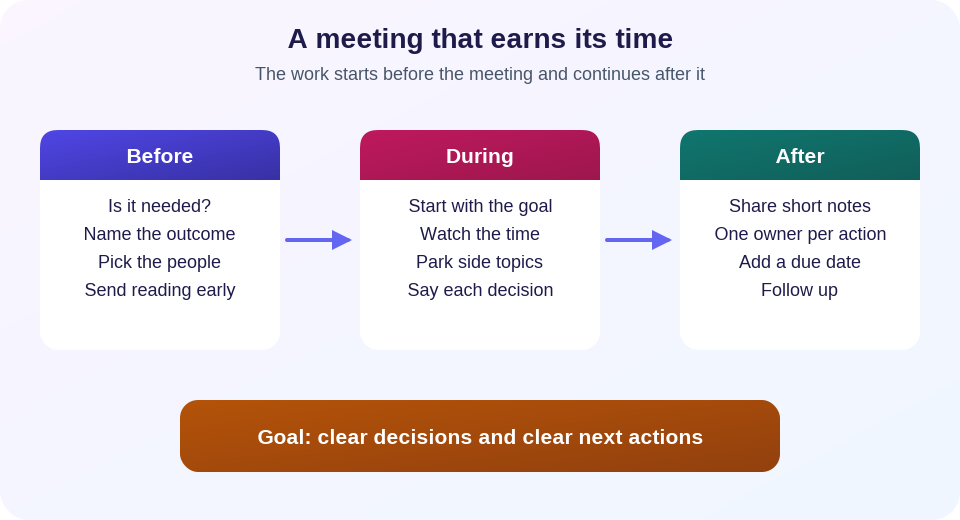
- Start with the outcome.
- Start on time when you can.
- Give someone the job of watching the time and someone the job of taking notes.
- Invite quieter people in, for example with a short round or time to write first.
- Place side topics on a parking list with a plan to handle them later.
- Say aloud when a decision has been made.
A parking list only builds trust if somebody looks at it afterward. A helpful phrase is: "That matters. May I put it on the later list so we can finish this decision?"
Close with actions
Use the last minutes to confirm:
- What was decided
- Each action
- One named owner for each action
- A due date
- Who needs to hear the result
"We should contact the venue" has no owner. "Rosa will email the venue by Tuesday and share the reply with the group" does. Send short notes soon afterward. If you record or transcribe a meeting, tell people and follow the consent rules, which differ by country and organization.
Your part as a participant
You can improve a meeting even when you do not lead it. Read the material before you come. Make your point briefly, and listen to the answers. If the talk drifts, ask a friendly question such as "Which decision are we working on now?" If the meeting is about to end without an owner for a task, ask, "Who will take this, and by when?" These small questions help everyone, including the person in charge.
Review repeating meetings
A repeating meeting can continue long after its reason has gone. From time to time, ask:
- What did this meeting produce recently?
- Could it be shorter or less frequent?
- Could part of it be a written update?
- Who still needs to attend?
Try a change for a few weeks, then review it together. If it is not your meeting, make a suggestion to the person who runs it.
When there is nothing useful on the agenda, cancelling a repeating meeting can be a good decision. Tell people early.
Common mistakes
- Using a meeting to read information that people could read on their own, with no time for questions or discussion.
- Inviting many people "just in case."
- Ending with ideas but no owner or date.
- Assuming silence means agreement. Ask directly and give people more than one way to answer.
Try it
Choose the best tool for each situation. Real workplaces may have good reasons to choose differently.
Check your understanding
Quick check · 4 questions
of 4 answered You scored / 4 · perfect!
-
1. Which agenda item describes an outcome?
It states what should be true when the discussion ends. -
2. What is the purpose of a parking list?
It keeps focus while showing that other topics are not forgotten. -
3. Which action is written most clearly?
It names an owner, an action and a date. -
4. A repeating meeting rarely produces anything now. What is a sensible step?
A shared review can shorten, change or end a meeting fairly.
Summary
- Choose the lightest tool that achieves the purpose.
- Write agenda items as outcomes or questions.
- Invite people with a clear role and pick the length on purpose.
- End with decisions, owners and dates.
- Review repeating meetings from time to time.
अपनी प्रगति ट्रैक करें
मुफ़्त अकाउंट बनाएँ, लेसन पूरे के रूप में चिह्नित करें और किसी भी डिवाइस पर वहीं से शुरू करें जहाँ छोड़ा था।