
























लेसन 1 · The Cyrillic Alphabet
Russian for Beginners: course map
See what this beginner Russian course covers, from the Cyrillic alphabet to cases, verbs and travel talk, and learn how to study each lesson well.
Russian is written in the Cyrillic alphabet. On the first day, a street sign may look like a puzzle. The good news is that the puzzle is small. There are 33 letters, and several of them already look familiar if you read English.
This course starts from zero. You do not need any Russian, and you do not need to know grammar words. Each new term is explained when it first appears.
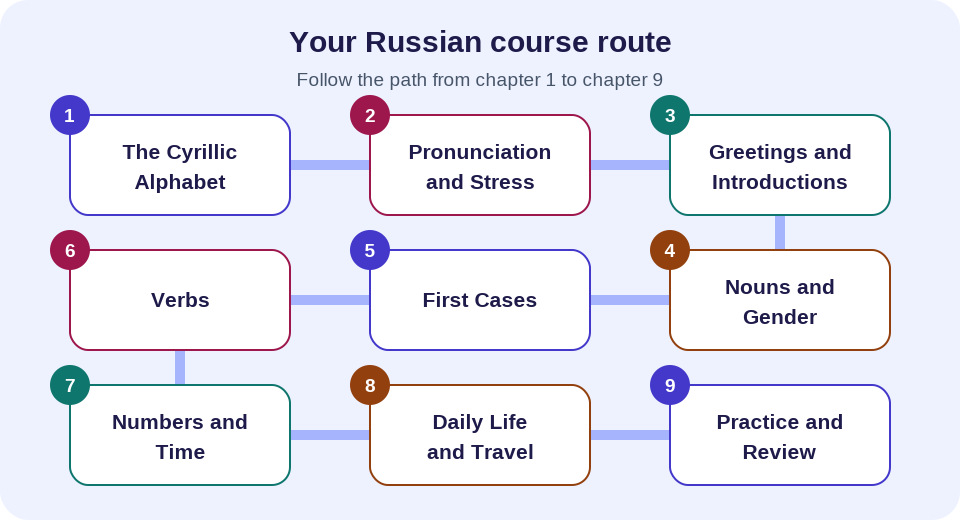
What you will learn
- what each of the nine chapters covers
- how Russian is shown in these lessons
- a simple study routine that works with short sessions
- what this course can and cannot do for you
The nine chapters
- The Cyrillic Alphabet. You learn all 33 letters in small groups and start reading real words.
- Pronunciation and Stress. You learn why a word is not always said the way it is spelled.
- Greetings and Introductions. You say hello, give your name, and use polite phrases.
- Nouns and Gender. You learn how to name things, point at them, own them and describe them.
- First Cases. Russian nouns change their endings to show their job in a sentence. You meet the first of these forms.
- Verbs. You learn to say what you do.
- Numbers and Time. You count, ask prices and talk about the clock and the calendar.
- Daily Life and Travel. You practice useful language for common situations.
- Practice and Review. You put everything together and check what you remember.
Chapters build on each other, so take them in order. Do not skip the alphabet. Every later lesson depends on it.
How Russian appears in these lessons
You will usually see three things together:
- the Russian text, for example спасибо
- a simple guide to the sound in Latin letters, for example spa-SEE-ba
- the meaning in English, "thank you"
In the sound guide, CAPITAL letters show the stressed syllable. A stressed syllable is the one you say with more force and length. The guide is only a rough help. English letters cannot copy every Russian sound, so treat it as training wheels. Try to stop looking at it as soon as you can.
Sometimes you will see a small mark over a vowel, as in спаси́бо. This mark also shows the stress. Ordinary Russian books, signs and messages do not print it. You find it mainly in dictionaries and learning materials. Do not copy it when you write.
Your first look at Russian words
You can probably guess these words after a few lessons. For now, just look at them.
| Russian | Sound guide | Meaning |
|---|---|---|
| мама | MA-ma | mom |
| кот | kot | male cat, cat |
| такси | tak-SEE | taxi |
| парк | park | park |
| ресторан | ris-ta-RAN | restaurant |
Many modern words are shared with other languages. When you can read the letters, words like these become free vocabulary. Be a little careful, though. Some words look familiar but mean something else. For example, магазин means a shop or store. It does not usually mean a magazine that you read, which is журнал.
A study routine that works
Short and frequent practice usually beats one long session. Try this plan for each lesson:
- Read the lesson once without stopping.
- Read it again and say every Russian example aloud.
- Do the Try it exercises until you can finish them without guessing.
- Write a few words by typing or by hand.
- The next day, review for five minutes before you start something new.
Keep one notebook or file for new words. For each noun, write the stress and, after chapter 4, its gender. This habit saves time later.
What this course cannot do
These pages have no audio. To train your ear, add listening practice from other places, for example Russian-language videos with subtitles, a dictionary that plays recordings, a teacher or a conversation partner. Listen first, then repeat. Your goal is to be understood. A perfect accent is not required.
If you want to type Russian, you can add a Russian keyboard in your device settings. It is not required here, because the exercises use buttons.
Worked example: using one lesson well
Suppose today's lesson teaches the word кот. Here is what good study looks like.
- Look at the Cyrillic and name each letter.
- Guess the sound before you check the guide.
- Check the guide, then cover it.
- Say the word three times, a little faster each time.
- Use it: point at a cat, or a picture of one, and say Это кот ("This is a cat").
This takes less than a minute. It trains your eyes, your mouth and your memory together.
How to know you are ready to move on
You do not need to be perfect before the next lesson. Move on when you can do these three things:
- read the new Russian examples without the sound guide, even if you read slowly
- explain the main rule in your own words
- get most Try it items right on a second attempt
If one of these is hard, repeat the lesson the next day. Going back is a normal part of learning a language.
Common mistakes
Staying with Latin letters. If you read only the sound guide, you never learn to read Russian. Look at the Cyrillic first.
Trying to learn all the grammar at once. Cases and verbs come later for a reason. Master one small step at a time.
Studying silently. Say words aloud. Your mouth needs practice too.
Try it
Put the stages of the study routine and the course in a sensible order.
Now take a first guess at five words. It is fine to guess.
Check your understanding
Quick check · 4 questions
of 4 answered You scored / 4 · perfect!
-
1. How many letters does the modern Russian alphabet have?
The modern Russian alphabet has 33 letters. -
2. What do capital letters show in the sound guide, as in spa-SEE-ba?
Capitals mark the syllable with the stress. -
3. Do ordinary Russian signs and messages print stress marks?
Stress marks appear mainly in dictionaries and learning materials. -
4. What does магазин usually mean?
This word looks like "magazine" but means a shop. A magazine to read is журнал.
Summary
- The course has nine chapters, from letters to review.
- Russian has 33 letters.
- Capitals in the sound guide show stress, and stress marks are a learning aid.
- Short daily practice, spoken aloud, works well.
- Add real listening practice, because these pages have no audio.
अपनी प्रगति ट्रैक करें
मुफ़्त अकाउंट बनाएँ, लेसन पूरे के रूप में चिह्नित करें और किसी भी डिवाइस पर वहीं से शुरू करें जहाँ छोड़ा था।