
























लेसन 31 · Questions and Difficult Moments
Prepare for Questions and Answers
Predict likely questions, prepare short answers, set clear rules for question time and run a calm Q&A that ends with your main message.
For many speakers, the question time feels like the riskiest part. The talk was planned. The questions are not. But you can prepare far more than you might think.
A question is often a good sign. It can show that someone is thinking about your idea, wants to use it or needs one more piece to understand it.
What you will learn
- How to predict likely questions
- How to prepare short, useful answers
- A five-step way to answer
- How to set up question time
- How to finish strongly
Predict the questions
Write down every question you think someone might ask. Use these prompts:
- Understanding: Which term or step might be unclear?
- Evidence: How do you know? Where does the number come from?
- Practical matters: What will it cost? Who does the work? When?
- Risks: What could go wrong? What if it does not work?
- Alternatives: Why not do something else?
- Personal effect: What does this mean for me?
Then ask a friend or colleague to hear your talk and question you. Ask them to include the question you hope nobody asks.
Prepare short answers
For each likely question, write notes, not a speech:
- A direct answer in one sentence.
- One reason or example.
- Where to find more, if useful.
For example, to the question "Who will water the plants in summer?":
We will use a shared rota. Each household takes one week, and two people have already offered to be backups. The draft rota is in the handout.
This is an invented case. In your answers, say only what is true. If something is not decided yet, say that it is not decided.
If you need extra data, put it in appendix slides or on a note card.
Know your limits
Decide in advance what you cannot or should not discuss: private information, matters outside your role, or things that are not yet announced. Prepare a polite sentence: "I can't discuss individual cases. I can explain the general process."
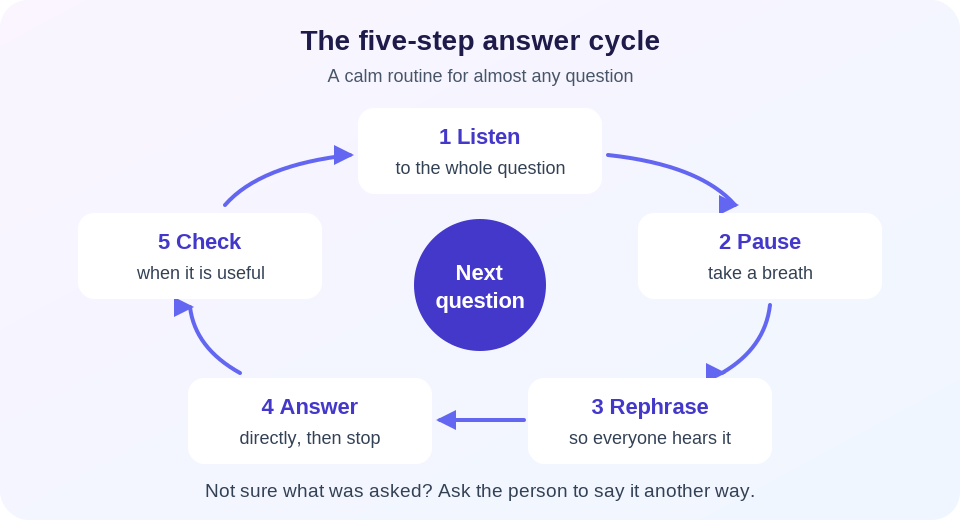
Five steps for any answer
- Listen to the whole question. Do not start planning your reply halfway through.
- Pause. A short silence shows you are thinking.
- Repeat or rephrase it for the room, especially if people may not have heard it. Keep the meaning fair. "The question is how we will cover summer holidays."
- Answer the question directly, then stop.
- Check briefly when useful: "Does that answer your question?"
If you are not sure what was asked, ask: "Do you mean the cost this year, or over several years?" If you cannot hear well or a word is new to you, ask the person to repeat or say it another way. This is completely normal, in a first or second language.
Look at the person who asked as the answer begins. Then include the rest of the room.
Set up question time
Tell the audience early when you will take questions:
| Choice | Good for | Watch out for |
|---|---|---|
| During the talk | Small groups, training, complex steps | Losing time and structure |
| After each section | Longer talks with clear parts | Long discussions |
| At the end | Short or formal talks | People forgetting questions |
Follow the event's rules if it has them. If there is a chair or moderator, agree on who chooses the questions, how long you have and how they will signal the final one.
Offer more than one way to ask when it makes sense: speaking, a written card, an online form or chat. Some people prefer not to speak in front of a group.
Start the questions
Silence after "Any questions?" is common. People need time to think and may not want to be first.
- Ask an open invitation: "What questions do you have?"
- Wait. Count slowly to yourself.
- Offer a starter: "People often ask about the cost. Here is the short answer."
- Give people a moment to talk with a neighbor, if the setting allows.
Share the floor
Try to take questions from different parts of the room and from people who have not spoken yet. Say, "Let's hear from someone new." If one person has many questions, offer to talk afterward.
End with your message
Do not let your talk finish on a random last question. Keep a short final close ready: "Thank you for your questions. Remember one thing: a shared rota keeps the garden alive. Sign-up sheets are by the door."
Announce the final question in advance: "We have time for one more." After you answer it, give your close.
A worked example
Kofi prepares for a talk about a new booking system. He lists ten questions and asks a coworker for more. The coworker asks, "What if someone has no smartphone?" Kofi has not thought about this. He checks with the team and learns that the front desk can make bookings. He adds the answer to his notes and also mentions it in the talk.
Common mistakes
Do not interrupt the question. Do not give a second talk as your answer. Do not change the question into an easier one without saying so. Do not guess at facts. Do not end on silence or on the sound of you packing up.
Try it
Flip each card. Say your answer aloud before you look at the suggestion.
Check your understanding
Quick check · 4 questions
of 4 answered You scored / 4 · perfect!
-
1. What is a good form for a prepared answer?
Short answers leave room for more questions. -
2. Why repeat or rephrase a question?
It includes the room and gives you a moment to think. -
3. Nobody speaks right after your invitation. What should you do?
People often need time before asking. -
4. How can you end after the last question?
A prepared close brings attention back to your main point.
Summary
- Brainstorm likely questions, including the hard ones.
- Prepare short, true answers.
- Listen, pause, rephrase, answer and check.
- Set clear ways and times to ask.
- Finish with your own close.
अपनी प्रगति ट्रैक करें
मुफ़्त अकाउंट बनाएँ, लेसन पूरे के रूप में चिह्नित करें और किसी भी डिवाइस पर वहीं से शुरू करें जहाँ छोड़ा था।