
























लेसन 14 · Reading Music
The Staff and the Treble Clef
Learn the five-line staff and the treble clef, name notes on lines and spaces, use landmark notes such as middle C and G, and find each note on the keys.
Reading music connects a dot on a page to a key on your instrument. At first it feels slow. With short daily practice, you start to recognize notes at a glance. This lesson begins with the staff and the treble clef.
What you will learn
- How the staff works
- What the treble clef tells you
- The notes on the treble lines and spaces
- How to use landmark notes
- How to connect notes to keys
The staff
The staff (plural staves) is five horizontal lines with four spaces between them. We number lines and spaces from the bottom up.
- A notehead sits on a line (the line goes through its middle) or in a space (between two lines).
- Higher on the staff means higher in pitch.
- Moving from a line to the next space, or from a space to the next line, moves one letter in the music alphabet.
The treble clef
A clef at the start of the staff tells you which notes the lines and spaces stand for. The treble clef is also called the G clef. Its curl wraps around the second line, which marks that line as G4, the G above middle C.
In piano music, the right hand often reads the treble clef, but not always. The clef tells you the pitch; it does not force a hand.
Lines and spaces
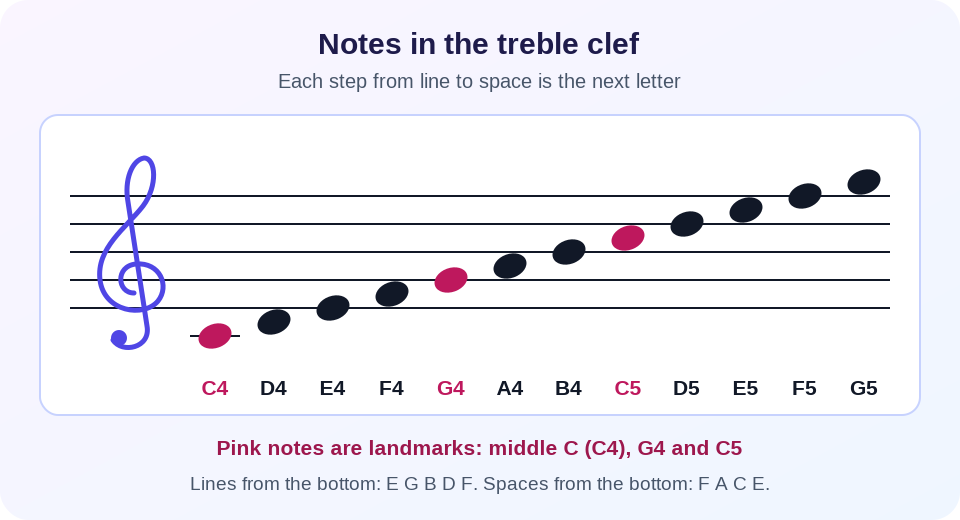
From bottom to top, the treble lines are:
E G B D F (E4, G4, B4, D5, F5)
Many students use a memory phrase, such as "Every Good Boy Does Fine". You can also invent your own.
From bottom to top, the spaces are:
F A C E (F4, A4, C5, E5)
They spell the word FACE.
| Position | Note | Position | Note |
|---|---|---|---|
| Bottom line | E4 | First space | F4 |
| Second line | G4 | Second space | A4 |
| Middle line | B4 | Third space | C5 |
| Fourth line | D5 | Fourth space | E5 |
| Top line | F5 |
Notes just outside the staff
- The note hanging just below the bottom line is D4.
- Middle C (C4) sits below that, on a short extra line called a ledger line.
- The note sitting just above the top line is G5.
Landmark notes
Memory phrases help, but counting through them for every note is slow. Landmarks are notes you know instantly. Other notes are found by stepping from them. Good treble landmarks:
- Middle C (first ledger line below)
- G4 (second line, the line the clef curls around)
- C5 (third space)
For example, you see a note one step above the G line. It is in the space above G, so it is A.
Connecting to the keyboard
Put your right hand in C position: thumb on middle C.
| Note | C4 | D4 | E4 | F4 | G4 |
|---|---|---|---|---|---|
| Staff position | Ledger line below | Just below staff | Bottom line | First space | Second line |
| Finger | 1 | 2 | 3 | 4 | 5 |
As the notes climb one step on the staff, you move one white key to the right.
A worked example
You see a note on the middle line. What is it, and where do you play it?
- The middle line is the third line from the bottom.
- Treble lines are E, G, B.
- So it is B4, the B just above middle C's group, one white key below C5.
You can check from a landmark too. G4 is on line two. The space above it is A, and the next line is B.
Practice routine
- Say the names of the lines and spaces from bottom to top, then top to bottom.
- Draw a blank staff and write the notes C4 to G4 from memory.
- Practice naming 20 random notes a day. Use the drill below or paper flashcards.
- Play each note on your instrument as you name it.
Short daily sessions of five minutes usually work well.
Stems do not change the pitch
A note's stem may point up or down. This makes the page tidier, but it does not change which note it is. Read the position of the notehead. In the same way, an open or filled head tells you about length, not pitch. So you read each note twice: its position gives the pitch, and its shape gives the duration.
Building speed without guessing
When you drill, wait until you are sure before you answer. Quick guesses can teach your brain the wrong link. If you hesitate on a note, find the nearest landmark and step to it. After enough correct repeats, the answer will come without the steps. Keep a short list of the notes you miss, and give them extra turns.
Writing as well as reading
Draw a staff and a treble clef. Ask yourself to write A4, then D5, then E4. Check each one with the table. Writing a note forces you to think from letter to position, which is the reverse of reading. Doing both directions makes the link stronger.
Common mistakes
- Counting lines from the top instead of the bottom.
- Forgetting that spaces are notes too.
- Always reciting the whole memory phrase instead of learning landmarks.
- Naming a note correctly but playing it in the wrong octave.
Try it
Name the note drawn on the treble staff.
Check your understanding
Quick check · 4 questions
of 4 answered You scored / 4 · perfect!
-
1. From which direction do you count staff lines?
Lines and spaces are numbered from the bottom up. -
2. Which note does the curl of the treble clef mark?
The treble clef is the G clef and wraps around the G line. -
3. What do the treble spaces spell from bottom to top?
The four spaces are F, A, C and E. -
4. Where is middle C in the treble clef?
Middle C sits on a ledger line just below the treble staff.
Summary
- The staff has five lines and four spaces, counted from the bottom.
- The treble clef marks G4 on the second line.
- Lines are E G B D F; spaces are F A C E.
- Landmark notes make reading faster.
Next: The Bass Clef
अपनी प्रगति ट्रैक करें
मुफ़्त अकाउंट बनाएँ, लेसन पूरे के रूप में चिह्नित करें और किसी भी डिवाइस पर वहीं से शुरू करें जहाँ छोड़ा था।