
























लेसन 32 · Getting Around
Asking for Directions
Ask where places are in Korean and understand answers with left, right, straight, position words and distance, using simple example maps.
Even with a map on your phone, you will sometimes need to ask a person. A short, polite question is usually enough. The harder part is understanding the answer.
This lesson gives you the question forms first. Then it trains your ear for the words you are most likely to hear.
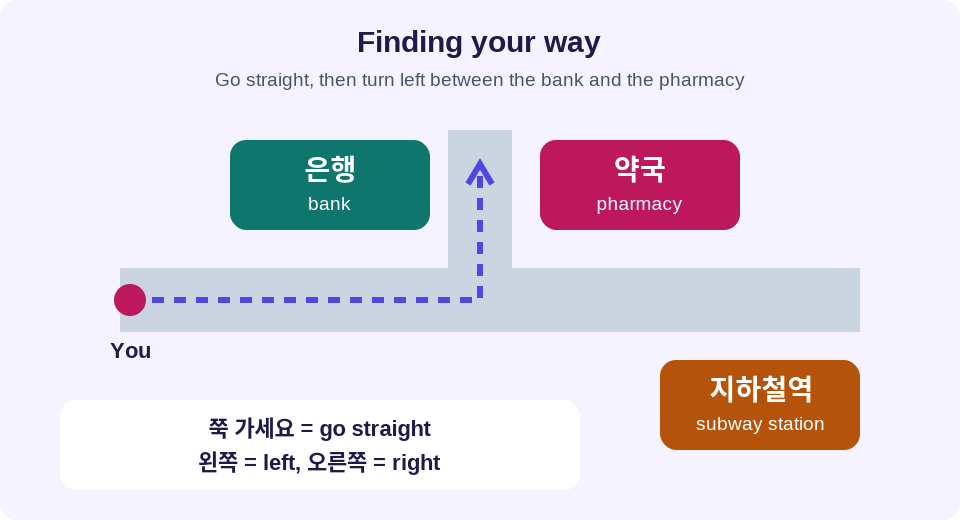
What you will learn
- How to ask where something is
- Names of common places
- Words for left, right, straight and across
- Position words such as "next to" and "in front of"
Places
| Korean | Romanization | Meaning |
|---|---|---|
| 화장실 | hwajangsil | restroom |
| 지하철역 | jihacheollyeok | subway station |
| 버스 정류장 | beoseu jeongnyujang | bus stop |
| 편의점 | pyeonuijeom | convenience store |
| 은행 | eunhaeng | bank |
| 병원 | byeongwon | hospital, clinic |
| 약국 | yakguk | pharmacy |
| 공원 | gongwon | park |
| 식당 | sikdang | restaurant |
| 호텔 | hotel | hotel |
Asking where
Start politely with 저기요 or 실례합니다 (excuse me).
- 화장실이 어디예요? (Hwajangsiri eodiyeyo?) Where is the restroom?
- 지하철역이 어디에 있어요? (Where is the subway station?)
- 이 근처에 약국이 있어요? (Is there a pharmacy near here?)
- 여기에 어떻게 가요? (How do I get here? Show an address or a map.)
Use 이 after a consonant and 가 after a vowel: 약국이, 카페가.
Here and there
| Korean | Meaning |
|---|---|
| 여기 | here |
| 거기 | there, near the listener or already mentioned |
| 저기 | over there |
Direction words
| Korean | Romanization | Meaning |
|---|---|---|
| 왼쪽 | oenjjok | left side |
| 오른쪽 | oreunjjok | right side |
| 쭉 가세요 | jjuk gaseyo | go straight |
| 왼쪽으로 가세요 | oenjjogeuro gaseyo | go left |
| 오른쪽으로 도세요 | oreunjjogeuro doseyo | turn right |
| 길을 건너세요 | gireul geonneoseyo | cross the street |
| 올라가세요 | ollagaseyo | go up |
| 내려가세요 | naeryeogaseyo | go down |
(으)로 here shows a direction. 도세요 comes from 돌다 (to turn). The ㄹ drops before 세요.
You may also hear 직진하세요 (go straight), especially from drivers and navigation voices.
Position words
Say the landmark, then the position word, then 에 있어요.
| Korean | Meaning |
|---|---|
| 앞 | in front |
| 뒤 | behind |
| 옆 | next to, beside |
| 건너편 | across from, the opposite side |
| 사이 | between |
| 위 | above, on |
| 아래 | below, under |
| 안 | inside |
| 밖 | outside |
- 은행 옆에 있어요. (It is next to the bank.)
- 역 앞에 있어요. (It is in front of the station.)
- 병원 건너편에 있어요. (It is across from the hospital.)
- 은행하고 약국 사이에 있어요. (It is between the bank and the pharmacy.)
- 지하에 있어요. (It is on the basement level.)
Distance
| Korean | Meaning |
|---|---|
| 가까워요 | It is close. |
| 멀어요 | It is far. |
| 여기에서 멀어요? | Is it far from here? |
| 걸어서 오 분쯤 걸려요. | It takes about five minutes on foot. |
쯤 (jjeum) means "about". 걸어서 means "by walking".
Floors
Floors use Sino-Korean numbers with 층: 일 층 is the first floor, which is usually the ground floor. 이 층 is the floor above it. 지하 일 층 is the first basement level. If you come from a country that calls the ground floor "floor zero", remember this difference.
A short dialogue
- You: 저기요, 이 근처에 편의점이 있어요? (Excuse me, is there a convenience store near here?)
- Person: 네. 쭉 가세요. 그리고 오른쪽으로 도세요. (Yes. Go straight. Then turn right.)
- You: 멀어요? (Is it far?)
- Person: 아니요, 가까워요. 은행 옆에 있어요. (No, it is close. It is next to the bank.)
- You: 감사합니다. (Thank you.)
Checking that you understood
Repeat the key words back: 왼쪽이요? (Left?) 은행 옆이요? (Next to the bank?) If it is still unclear, say 천천히 말해 주세요, or ask them to point on your map.
Not every person has time to help, and some may not know the area. A station worker, a shop worker or an information desk can be a good place to ask.
Understanding longer answers
A real answer may join several steps. Listen for the order words, which help you keep track.
| Korean | Meaning |
|---|---|
| 먼저 | first |
| 그다음에 | after that |
| 마지막으로 | finally |
For example: 먼저 쭉 가세요. 그다음에 왼쪽으로 가세요. 약국이 보일 거예요. This means: "First go straight. After that, go left. You will see a pharmacy." 보일 거예요 uses the future pattern from earlier in the course.
You may also hear a distance in meters: 백 미터쯤 가세요 (go about 100 meters). Meters take Sino-Korean numbers.
Practice giving directions as well as receiving them. Choose a route you know well, such as the way from your home to a shop. Say it in three short steps, using one direction word in each. Then ask a partner to draw the route from your words. If the drawing is wrong, find which word caused the problem and practice it again.
A final check
Before you walk away, repeat the whole route once in a short form, for example 직진하고 왼쪽이요? This uses 고 to join the steps. The helper can then correct you at once. Finish with 감사합니다, even if the answer was that they do not know the way. A polite ending takes one second.
Common mistakes
- Putting the position word first, as in 옆 은행에. Say 은행 옆에.
- Mixing up 왼쪽 and 오른쪽. Practice them with your own hands.
- Saying 어디 있다 to a person. Say 어디에 있어요?
- Assuming 일 층 is one floor above the ground.
Try it
Check your understanding
Quick check · 4 questions
of 4 answered You scored / 4 · perfect!
-
1. How do you say next to the bank?
The landmark comes first, then the position word. -
2. What does 오른쪽 mean?
오른쪽 is the right side and 왼쪽 is the left side. -
3. What does 쭉 가세요 mean?
쭉 describes continuing straight ahead. -
4. Which question asks whether there is a pharmacy nearby?
근처 means nearby.
Summary
- Start with 저기요 and ask 어디예요? or 있어요?
- Learn 왼쪽, 오른쪽 and 쭉 가세요 well.
- Give a position as landmark, position word and 에 있어요.
- Repeat key words back to check your understanding.
Next: Subway, Bus and Taxi
अपनी प्रगति ट्रैक करें
मुफ़्त अकाउंट बनाएँ, लेसन पूरे के रूप में चिह्नित करें और किसी भी डिवाइस पर वहीं से शुरू करें जहाँ छोड़ा था।