
























लेसन 6 · Line and Shape
Line Control: Straight Lines and Curves
Practice straight lines, curves and ellipses with dot to dot lines, ghosting, parallel hatching and simple drills that build a steady hand.
Lines are the alphabet of drawing. Before you build boxes and faces, it helps to place a line roughly where you want it.
Perfect lines are not the goal. A confident line that is a little off is usually better than a slow, shaky, scratchy one. This lesson gives you simple drills to build that confidence.
What you will learn
- How to draw a straight line between two points
- What ghosting is and why it helps
- How to practice parallel lines and curves
- How to warm up loose ellipses
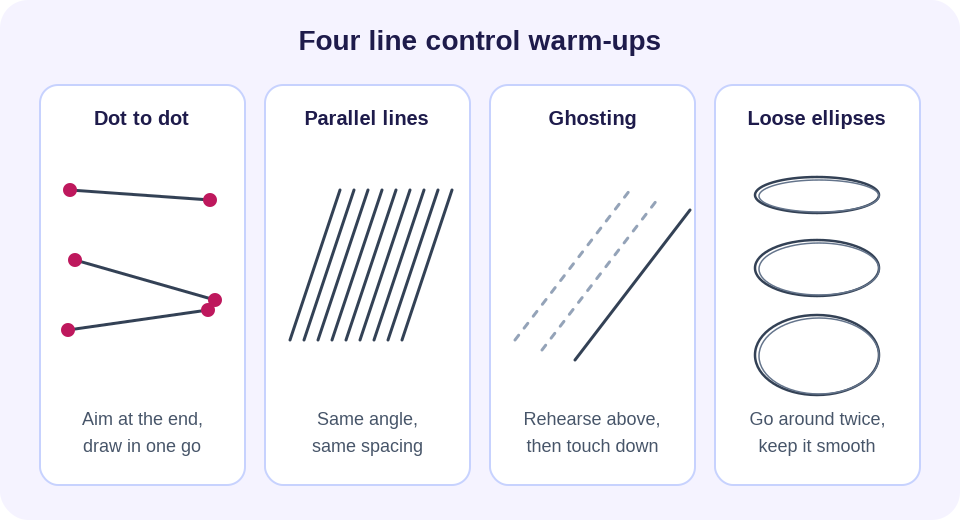
One stroke, not many
Beginners often make "hairy" lines: many short strokes that slowly creep toward a shape. This hides where the line really is, and it can become a habit.
Try to draw each edge with one smooth stroke, or a few long ones. If the line misses, leave it and draw another. With light pressure, your extra lines stay soft and easy to ignore.
Hairy strokes are not always wrong. Some artists use them as a style. For control practice, aim for single strokes so you can see what your hand is doing.
Dot to dot
- Draw two small dots on your page.
- Look at the end dot, not at your pencil tip.
- Draw one stroke from the start dot to the end dot.
- Check how close you were.
Looking at the target is a little like throwing a ball. Your eyes aim and your arm follows.
Start with short lines, then make them longer. Try different directions. Notice which ones feel hard and practice them a bit more.
Ghosting
Ghosting means rehearsing a stroke in the air just above the paper before you touch it.
- Place your pencil above the start point.
- Move it back and forth over the path a few times without marking.
- When the motion feels smooth, lower the pencil and draw the line in the same rhythm.
Ghosting helps you plan the direction and the length. It also helps you commit to a speed. Do not rehearse forever. Two or three passes are enough for most strokes.
Speed
Very slow strokes often wobble. Very fast strokes may fly past the target. Find a steady, moderate speed. Try the same line at three speeds and compare. Pick what gives you the best balance of smoothness and accuracy.
Parallel lines
Parallel lines stay the same distance apart and do not meet on a flat page.
- Draw one line.
- Draw a second next to it with the same angle and spacing.
- Repeat until you have ten or more.
Watch for lines that slowly rotate. If they start to fan out, stop and check against your first line. You will use parallel lines for shading with hatching later.
Try these variations:
| Drill | Goal |
|---|---|
| Flat lines | Even spacing and level direction |
| Upright lines | Same angle across the whole block |
| Diagonal lines | Smooth motion in your easier and harder directions |
| Shrinking spacing | A smooth change from wide to narrow |
Curves
Practice curves in families:
- C curves bend one way.
- S curves bend one way and then the other.
Draw several C curves nested inside each other, like a rainbow. Then draw rows of S curves that flow in the same way. Aim for smooth bends without sudden corners.
To draw a curve through points, place three or four dots first. Ghost the path, then draw one flowing stroke through them.
Ellipses
An ellipse is a smooth oval. It has two axes. The major axis is the longest line across it. The minor axis is the shortest, and it crosses the major axis at a right angle.
Warm up like this:
- Draw a row of small boxes.
- Fill each box with an ellipse that touches all four sides.
- Go around two or three times without lifting.
- Keep it smooth, with no pointed ends and no flat sides.
Ellipses are very important for cups, bottles and wheels. You will practice them again in Ellipses and cylinders.
Checking your drills
After a page of drills, mark the three lines you like best. Ask yourself what your arm did on those. Did you move from the elbow? Did you ghost first? Then repeat what worked.
Fill the corner of a page with drills before each session. Five minutes is plenty. Date it so you can compare weeks later.
Keep a record
Once a week, repeat the same small test: five dot to dot lines, one block of parallels and a row of ellipses. Put the date on the page. Comparing these test pages shows change more clearly than your memory can.
Common mistakes
- Drawing with many tiny scratchy strokes during control practice.
- Staring at your pencil tip instead of the target point.
- Using only your fingers for long lines.
- Pressing hard before you know where the line should go.
Try it
Draw a line from the pink dot to the blue dot with your mouse or finger in one stroke. The score shows the average distance between your path and the ideal straight line, in screen pixels.
A mouse is harder to control than a pencil, so do the same drill on paper too.
Check your understanding
Quick check · 4 questions
of 4 answered You scored / 4 · perfect!
-
1. Where is it often helpful to look when drawing a line to a dot?
Looking at the target helps your arm aim at it. -
2. What is ghosting?
You rehearse the motion first, then draw. -
3. Which axis of an ellipse is the longest?
The major axis is the longest line across the ellipse. -
4. What might happen with a very slow stroke?
A steady, moderate speed usually gives a smoother line.
Summary
- Prefer single confident strokes during control practice.
- Aim your eyes at the end point.
- Ghost a stroke, then draw it.
- Practice parallels, C and S curves, and smooth ellipses.
- Review your best lines and repeat what worked.
Next: Line Weight and Quality
अपनी प्रगति ट्रैक करें
मुफ़्त अकाउंट बनाएँ, लेसन पूरे के रूप में चिह्नित करें और किसी भी डिवाइस पर वहीं से शुरू करें जहाँ छोड़ा था।