
























Leçon 1 · Foundations and Nerves
Public Speaking Course Map: How to Use This Tutorial
See the full public speaking course, from nerves and audience analysis to delivery, slides and questions, and learn how to practice between the lessons.
Public speaking is any time you talk to a group on purpose. It can be a class presentation, a team update, a wedding toast or a talk at a conference. The size changes, but the core skills stay the same.
You do not need a special voice or a loud personality. You need a clear message, a simple structure and practice. All three can be learned, including in a second language.
What you will learn
- How the nine chapters of this course fit together
- What a good talk does for its listeners
- How to practice so that each lesson changes how you speak
- How to record a starting point and measure progress
The nine chapters
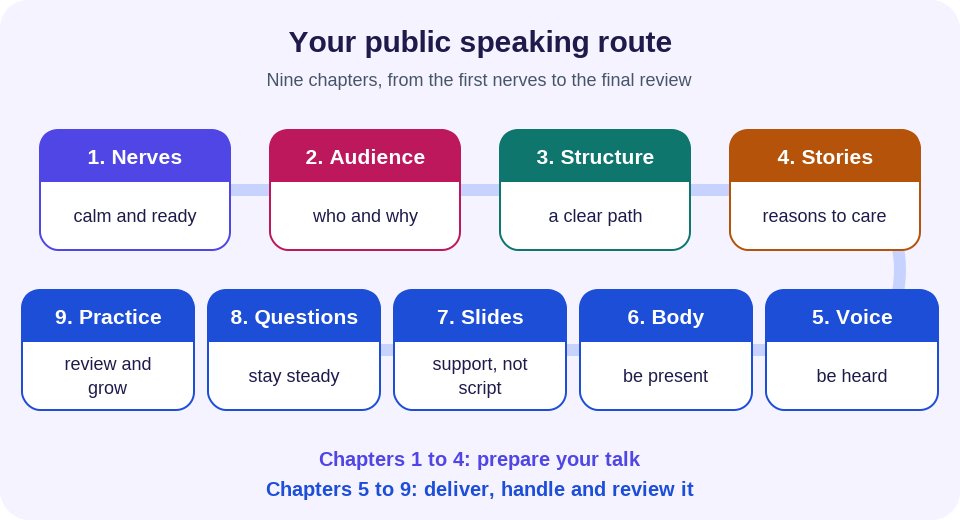
The first four chapters help you prepare. First, you work on foundations and nerves. Next, you study your audience and purpose. Then you learn to structure a talk, and to use stories and persuasion.
The last five chapters move from the page to the room. They cover voice and delivery, body language and presence, slides and visuals, questions and difficult moments, and finally practice and review.
The order matters. A strong voice cannot rescue a talk with no clear point. When you know who you are talking to and what you want to say, delivery becomes much easier.
You can still jump ahead. If you speak tomorrow and feel very nervous, start with calming techniques. If your talk feels messy, go to the talk blueprint.
What a good talk does
Many beginners think the goal is to look impressive. That goal puts all your attention on yourself, and it often makes nerves worse. A more useful goal is to help your listeners understand, feel or do something.
A good talk usually does four things:
- It is relevant. The listeners can see why it matters to them.
- It is clear. They can repeat the main point afterward.
- It is easy to follow. They know where you are and where you are going.
- It is honest. You do not claim more than you know.
Notice what is missing from this list. A good talk does not need to be perfect. You can pause, check your notes or correct a word, and still give an excellent talk.
Talking and writing are different
A reader can stop, go back and read a sentence again. A listener cannot. Your words pass once, in real time. This changes how you should build a talk.
- Use shorter sentences than you would in an essay.
- Repeat your main idea more than once.
- Say what is coming before it comes.
- Give examples soon after general ideas.
Here is a written sentence: "The implementation of the new booking system, which was delayed, will commence in May." A spoken version is easier: "We have a new booking system. It was late, but it starts in May."
If you speak English as a second language, this is good news. Simple sentences are not a weakness on stage. They are often the better choice for everyone.
How to practice with this course
Reading about speaking is like reading about swimming. It helps, but you also need to get in the water. Use this small routine for each lesson.
- Read the lesson once.
- Do the exercise in the Try it section.
- Say something out loud for one or two minutes, using the new idea.
- Write one thing that worked and one thing to try next.
Speaking out loud is the key step. A sentence that sounds fine in your head may be hard to say. You only find this out by saying it.
You can practice alone in a room, with a friend, or with a phone that records you. Start with the option that feels manageable. Later lessons show you how to make practice a little harder, one step at a time.
Record a starting point
Before you go further, make a short recording if you can. Speak for one minute about something you know well, such as your morning routine or a hobby. Do not prepare for long.
Save the recording and write down three notes:
- How nervous did you feel, from 0 to 10?
- Could a listener name your main point?
- What is one thing you did well?
After a few weeks, record the same topic again and compare. Progress in speaking is often hard to feel from the inside. A comparison makes it visible. If recording is too much today, just speak aloud and write the three notes.
Worked example: Choosing where to start
Maria has to present a project update in ten days. She is a little nervous, and her draft is a long list of everything her team did.
Her best path is short. She reads the nerves lessons, then the lesson on the purpose statement and the talk blueprint. She cuts her list down to three points. She practices aloud four times before the day.
Daniel has a different problem. He knows his topic well but avoids any chance to speak. For him, the confidence ladder is the right first step.
Common mistakes
- Reading many lessons without ever speaking out loud.
- Waiting to feel confident before you practice. Confidence usually grows after practice, not before it.
- Comparing your first attempts with edited videos of experienced speakers.
- Trying to fix everything at once. Choose one skill for each practice session.
Try it
Pick your biggest current challenge, then build a small study plan from your answers.
Read your finished plan aloud. That is your first practice session.
Check your understanding
Quick check · 4 questions
of 4 answered You scored / 4 · perfect!
-
1. What is usually the most useful goal for a talk?
A listener-centered goal guides your choices and moves attention away from yourself. -
2. Why should spoken sentences often be shorter than written ones?
Speech passes once in real time, so it has to be easy to process. -
3. Which practice step is the most important to add after reading?
Speaking is a physical skill, so you need to do it aloud. -
4. Why record a short starting talk?
Change is hard to feel from the inside. A comparison makes it easier to see.
Summary
- Public speaking is a set of skills you can learn.
- Prepare first: nerves, audience, structure, stories. Then work on delivery, slides, questions and review.
- A good talk is relevant, clear, easy to follow and honest. It does not need to be perfect.
- Spoken language should be simpler than written language.
- Practice out loud after every lesson, and keep a starting point for comparison.
Suivez votre progression
Créez un compte gratuit pour cocher vos leçons et reprendre où vous vous étiez arrêté, sur n'importe quel appareil.