
























Leçon 24 · Synthesis and Sampling
Oscillators and Waveforms
Meet the synth oscillator: sine, triangle, square, sawtooth and noise, their harmonics, tuning, detune and the basic signal chain of subtractive synthesis.
A synthesizer makes sound from electronic or digital signals. Once you understand a few building blocks, you can shape your own sounds instead of only scrolling through presets.
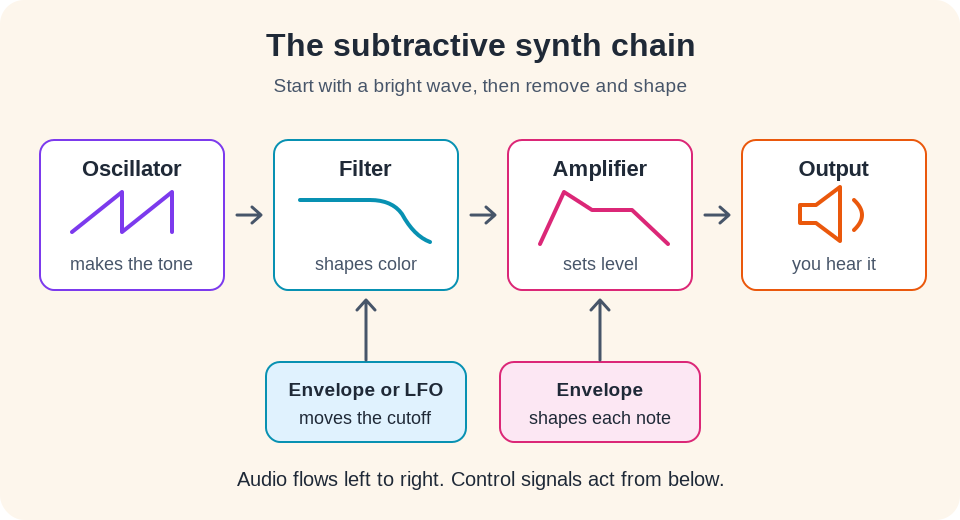
This chapter starts with subtractive synthesis. You begin with a sound that is rich in frequencies. Then you remove some of them and shape the result. The same ideas appear in many other synths.
What you will learn
- What an oscillator does
- How common waveforms differ in harmonic content
- How pitch, octaves and detune work
- How the basic signal chain fits together
The oscillator
An oscillator produces a repeating signal. The number of repeats per second is its frequency, measured in hertz (Hz). A higher frequency sounds higher.
A common tuning reference is A4 = 440 Hz. Going up one octave doubles the frequency, so A5 is 880 Hz and A3 is 220 Hz.
Harmonics
Most repeating sounds contain more than one frequency. The lowest is the fundamental. Harmonics are whole-number multiples of it. For a 100 Hz note, the harmonics are at 200 Hz, 300 Hz, 400 Hz and so on. Their relative strength is a large part of the tone color, or timbre.
Common waveforms
These descriptions are for ideal waveforms.
| Waveform | Harmonics present | How their level falls | Typical impression |
|---|---|---|---|
| Sine | Fundamental only | None to fall | Pure, soft |
| Triangle | Odd harmonics | Quickly, as 1 ÷ n² | Mellow |
| Square | Odd harmonics | As 1 ÷ n | Hollow |
| Sawtooth | Odd and even harmonics | As 1 ÷ n | Bright, buzzy |
Here n is the harmonic number. In a sawtooth, the third harmonic has one third of the fundamental's amplitude. In a triangle, it has only one ninth.
A pulse wave is a relative of the square wave. Its pulse width is the part of each cycle spent in the high state. At 50%, it is a square wave. Changing the width changes the tone. Narrow pulses often sound thin and nasal. Moving the width slowly is called pulse-width modulation.
Noise has no single clear pitch. White noise has equal power in each equal-width frequency band. It is useful for hi-hats, snares, wind effects and risers.
Real synths, especially analog ones, may not produce perfect shapes. That is one reason two synths can sound a bit different.
Why start bright?
A filter can reduce harmonics that exist. It cannot remove what is not there. If you put a sine wave into a low-pass filter, you mostly hear it get quieter once the cutoff goes near or below its frequency. A sawtooth gives the filter much more to work with.
Tuning and detune
Synths usually offer coarse tuning in octaves or semitones, and fine tuning in cents. One semitone is 100 cents. One octave is 12 semitones, or 1,200 cents.
With two oscillators you can try:
- Unison with slight detune: tune them a few cents apart. They drift in and out of step, which creates movement. This is called beating.
- Octave layering: put one an octave below to add weight.
- Intervals: tune one 7 semitones up to add a fifth. Every key then plays two notes, which can clash with some chords.
The beat rate equals the difference between two close frequencies. Sines at 440 Hz and 442 Hz beat twice per second.
Many synths also have a unison mode that stacks several copies of one voice. It sounds large, but it can blur a bass or weaken the sound in mono. Check it.
The signal chain
A typical subtractive voice has this path:
- Oscillators create the raw tone.
- A filter shapes its frequencies.
- An amplifier controls its level over time.
- Effects may follow.
Envelopes and LFOs do not usually make audible sound here. They control other settings. You study them in the next lesson.
A monophonic synth plays one note at a time. A polyphonic synth can play several. Monophonic mode is common for bass and lead lines.
New tones can be surprisingly loud, especially with resonance or stacked voices. Turn your monitoring down before you experiment, particularly with headphones. Long loud sessions can damage your hearing.
Worked example: exploring with your eyes and ears
Load a plain patch with one oscillator and an open filter. Hold the same middle note and switch between sine, triangle, square and sawtooth. Keep the level modest, and match the loudness as well as you can.
If your DAW has a spectrum analyzer, put it after the synth. With a sine wave you should see one main peak. With a sawtooth you should see a row of peaks at whole-number multiples of the lowest one. With a square wave, every second peak in that row is missing. A real or modeled synth may show small extra details, which is normal.
Next, play the same waveform in a low and a high register. A bright shape can sound thick and buzzy down low, yet thin and sharp up high. This is why a patch that works as a bass may not work as a lead. Write one or two words for what you hear on each waveform. Your own vocabulary will help you choose a starting point later.
Common mistakes
- Using many detuned voices on a deep bass and then losing its focus.
- Expecting a filter to add brightness to a pure sine wave.
- Confusing cents with semitones.
- Judging a patch only alone. It has to work with the other parts.
Try it
This drawing builds waveforms by adding harmonics. Raise the number of harmonics and watch each shape become sharper. It is silent, so focus on the picture.
Check your understanding
Quick check · 4 questions
of 4 answered You scored / 4 · perfect!
-
1. Which ideal waveform contains only the fundamental?
A sine wave is a single frequency. -
2. What is the frequency one octave above 220 Hz?
An octave up doubles the frequency. -
3. Which harmonics does an ideal square wave contain?
The fundamental is harmonic 1, and the others are 3, 5, 7 and so on. -
4. How many cents are in one semitone?
A semitone is 100 cents, and an octave of 12 semitones is 1,200 cents.
Summary
- Oscillators create repeating signals, and frequency sets pitch.
- Harmonic content is a large part of tone color.
- Sawtooth and square waves give filters plenty to shape.
- The basic path is oscillator, filter, amplifier, then effects.
Suivez votre progression
Créez un compte gratuit pour cocher vos leçons et reprendre où vous vous étiez arrêté, sur n'importe quel appareil.