
























Leçon 1 · Understanding the Test
IELTS Course Map: What You Will Learn
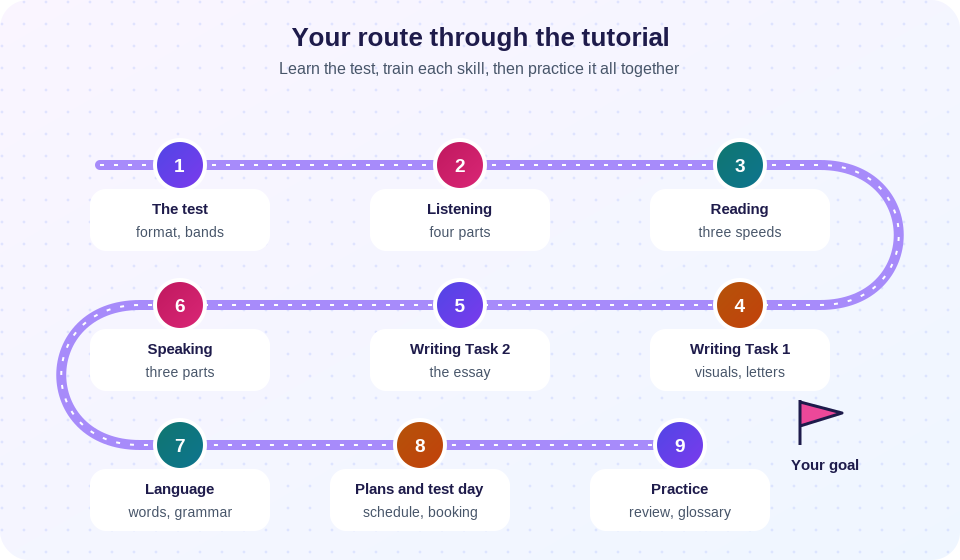
See the whole IELTS preparation tutorial on one page: the nine chapters, how to use the practice tools, and a sensible order for studying.
IELTS (the International English Language Testing System) tests how well you use English for study, work or moving to another country. Good preparation has two parts. You need stronger English, and you need to know exactly what each task asks you to do. This tutorial works on both.
This first lesson is your map. It shows what each chapter covers, how to use the exercises, and where to start if you are short of time.
This is an independent tutorial. It is not produced, approved or endorsed by the owners of IELTS. All practice texts, charts and questions here are our own, and none come from real exams. Test rules can change, so always confirm the current details on the official website, ielts.org.
What you will learn
- What the nine chapters cover and how they connect
- How to study with the interactive exercises
- What this site can and cannot do for you
- How to choose a study order that fits your situation
The nine chapters
| Chapter | What you work on |
|---|---|
| 1. Understanding the Test | Format, timings, band scores, your starting point |
| 2. Listening | The four parts and the main question types |
| 3. Reading | Skimming, scanning, True/False/Not Given, headings and more |
| 4. Writing Task 1 | Charts, processes, maps and, for General Training, letters |
| 5. Writing Task 2 | The essay |
| 6. Speaking | The three parts of the interview |
| 7. Language for a Higher Band | Vocabulary, grammar and cohesion |
| 8. Study Plans and Test Day | Schedules, booking and the day itself |
| 9. Practice and Review | Practice sets, a glossary and a cheat sheet |
Chapters 1 to 4 begin with the test format, band scores and your starting level. After that come Listening, Reading and Writing Task 1.
Learn the test
Train each skill
Practice and review
How to study each lesson
Each lesson follows the same pattern. You read a short explanation with worked examples, study a list of common mistakes, try one or more exercises, and finish with a quiz.
Use this four-step routine:
- Read the method. Do not skip the examples. They show how the method works on a real sentence.
- Try before you look. In an exercise, choose or type every answer before you press the check button.
- Explain each error. Say why the right answer is right. "I did not know the word" and "I read too fast" need different fixes.
- Write it down. Keep an error log in a notebook. The exercises do not save anything when you leave the page.
Worked example: one useful error log entry
| Weak entry | Useful entry |
|---|---|
| "Reading: 6 wrong." | "I chose False when the text did not mention cost. Next time: find the exact claim. If the text is silent about it, choose Not Given." |
The useful entry names the cause and gives you an action for next time.
What this site can and cannot do
The exercises compare your answer with an answer key. A gap-fill box accepts only the answers in that key, so a different correct phrasing may be marked as a mismatch. Read the explanation and judge for yourself.
The site cannot hear you, grade your essays or give you a band score. For feedback on Writing and Speaking, ask a qualified teacher or a skilled study partner. Some listening exercises offer a computer voice. It does not work in every browser, so each one also has a script.
Choose your order
- You have several months. Follow the chapters in order and spend extra time on your weakest skill.
- You have a few weeks. Read chapter 1, then train the two skills where you lose the most marks. Do timed practice often.
- You know the test but need a higher score. Start with your starting level, then work on your gaps and on the language chapter.
These are suggestions, not guarantees. How fast your English improves depends on your starting level and on how much good practice you do.
A worked example of planning from the map
Imagine a learner called Sofia. Her university asks for a particular overall band and a minimum in each skill. She has eight weeks. She does not start at lesson one and hope for the best. She does this instead:
- She reads the university page and copies the exact requirement into her notebook.
- She reads the format lesson, so that no task surprises her.
- She takes a timed diagnostic and finds that Writing is furthest from her target, followed by Reading.
- She gives Writing and Reading most of her study sessions. She still does a short listening and speaking activity each week, so those skills do not fade.
- After three weeks she checks again with new material and adjusts the plan.
Her plan is not "do everything equally". It follows the evidence from her own results.
Words you will see often
| Term | Plain meaning |
|---|---|
| Band | The score level that IELTS reports |
| Task type | A kind of question with its own rules, such as matching headings |
| Paraphrase | The same idea in different words |
| Distractor | A wrong option that looks attractive |
| Criterion (plural: criteria) | One of the points examiners use to judge writing or speaking |
If English is not your first language, you do not need to learn these all at once. Each one is explained again in the lesson where you need it.
Common mistakes
Many learners only do practice tests, check the score and start another one. A test measures your skill. It does not build it by itself. Spend as much time studying your errors as you spent making them.
Try it
Check your understanding
Quick check · 4 questions
of 4 answered You scored / 4 · perfect!
-
1. What can the exercises in this tutorial do?
The exercises check against a fixed key. They cannot hear you or grade extended writing. -
2. Where should you confirm the current test rules?
Rules and delivery options can change, so use the official source. -
3. Which error log entry is the most useful?
It names the cause and gives a clear action. -
4. What should you do after a practice set?
Studying your errors is what turns practice into progress.
Summary
- The tutorial moves from the test format to the four skills, language work, planning and review.
- It is independent. Confirm test details on ielts.org.
- Try first, check, explain your errors and keep your own error log.
- The site cannot hear or grade you. Get human feedback for Writing and Speaking.
Suivez votre progression
Créez un compte gratuit pour cocher vos leçons et reprendre où vous vous étiez arrêté, sur n'importe quel appareil.