
























Leçon 32 · Playing Songs and Styles
How to Learn a Song
Learn songs faster by mapping their sections, preparing chords and rhythm, practicing hard changes separately and playing through without stopping.
Learning a whole song can feel like a large job. It gets much easier when you split it into parts. Most songs repeat their sections, so there is less new material than it first appears.
In this lesson you will use a method you can apply to any song at your level.
What you will learn
- The common names of song sections
- How to make a simple song map
- A step-by-step practice method
- How to keep going when you make a mistake
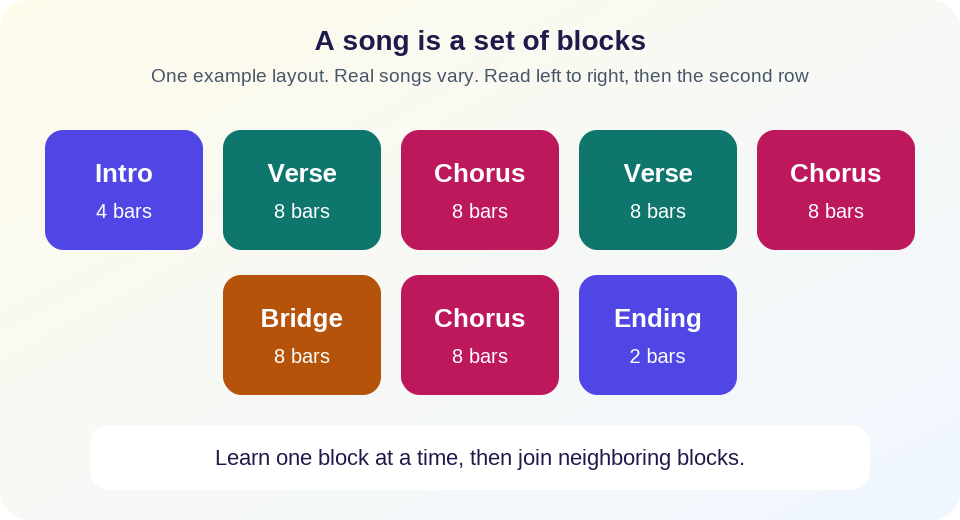
Common song sections
- Intro: the opening before the singing or main melody.
- Verse: a section whose music usually repeats, often with new words.
- Chorus: a section that usually returns with similar words and music.
- Bridge: a contrasting section, often heard once.
- Ending (or outro): how the song finishes.
Not every song has all of these, and some use other layouts. Listen first and write down what you actually hear.
Make a song map
Listen to the whole song with no guitar. Write each section as it starts. Add the number of bars if you can count them. Then add the chords above or beside each section.
A made-up example:
Intro   (4 bars):  G  C  G  D
Verse   (8 bars):  G  C  G  D   x2
Chorus  (8 bars):  C  D  G  Em  x2
Bridge  (8 bars):  Em  C  G  D   x2
Ending  (2 bars):  G  G
Now you can see that only a few chord patterns need learning.
Prepare before you play
- Chords: can you place each one cleanly? Check any new shapes.
- Changes: which two chords are hardest to move between? Practice only that pair.
- Rhythm: tap the strumming pattern on your leg while counting.
- Tempo: find a slow speed where you can succeed.
Learn in blocks
Start with the section you hear most, often the chorus. Play it with a simple strum, such as one downstroke per beat. When that is steady, use the song's strumming pattern. Then learn the verse the same way.
Now join two blocks. Practice the last bar of one and the first bar of the next. This is where players often stop.
A worked example: the hard change
In the made-up chorus above, suppose G to Em is difficult. Do this:
- Move between G and Em without strumming, ten times.
- Strum once on each, with four slow beats per chord.
- Play the full chorus at half your goal speed.
- Add the strumming pattern again.
Spending a few minutes on one weak spot helps more than playing the whole song many times.
Play through without stopping
When all blocks work, play the whole song. If you make a mistake, keep counting and rejoin at the next beat or chord. This skill matters a lot when you play with others or for an audience. Later, go back and fix the weak spot on its own.
You can strum a simpler pattern whenever the full one breaks. Simple and in time sounds better than complex and stopping.
Using recordings carefully
Playing along helps with timing and feel. If a recording is too fast, many music players let you slow it down. Learn the chords from trusted sources and check them against your ears, because online charts can contain mistakes. When you share or perform other people's songs, copyright rules apply, and they differ by country.
Playing with others
When you play with someone else, agree on the key, the tempo and who counts in. A clear count such as "1, 2, 3, 4" gets everyone starting together. Listen more than you play loudly.
Keep a song list with three columns: ready, nearly ready and new. Play one "ready" song at the end of each session.
Choosing the right song
A good first song makes success possible. Look for a song with:
- three or four chords you already know, or nearly know
- a moderate or slow tempo
- a rhythm you can hum easily
- a structure that repeats
A song far above your level can still be fun to explore, but it may make you feel stuck. Choose one "easy win" song and one "stretch" song.
Counting bars
When you listen, count "1, 2, 3, 4" and raise a finger each time you finish a bar in 4/4 time. Many sections are 4, 8 or 16 bars long, but not all. If a section feels odd, count it again before you decide.
Memorizing
Once you can play through a song with a chart, start to cover parts of it. Memorize the chorus first. Say the chords in order without the guitar. Even if you keep the chart nearby, knowing the structure will help you recover after a mistake.
Playing for someone
Play a finished song for a friend or family member, or record it. Playing for a listener often feels different. It shows you which parts need more practice. Notice what went well, too.
Common mistakes
- Starting from the top after every mistake, so the ending never gets practice.
- Learning at full speed before the changes are clean.
- Skipping the transitions between sections.
- Trusting a single chart without checking by ear.
Try it
Build a simple song map. Add sections, then check the total number of bars.
Check your understanding
Quick check · 4 questions
of 4 answered You scored / 4 · perfect!
-
1. Which section usually returns with similar words and music?
A chorus is typically the repeating part. -
2. What should you practice to join two sections smoothly?
The transition is where many stops happen. -
3. You make a mistake while playing through. What is a good habit?
Keeping time is a valuable performance skill. -
4. Why check an online chord chart by ear?
Not every chart is accurate.
Summary
- Map the sections before you learn them.
- Prepare chords, changes, rhythm and tempo.
- Learn in blocks and practice the joins.
- Keep time through mistakes, then fix weak spots alone.
- Check charts by ear and respect copyright rules.
Suivez votre progression
Créez un compte gratuit pour cocher vos leçons et reprendre où vous vous étiez arrêté, sur n'importe quel appareil.