
























Leçon 24 · Sentence Stress and Rhythm
Sentence stress: which words carry the beat
Learn which words English speakers usually stress in a sentence, why small grammar words stay light, and how the main stress guides your listener.
In English, not every word in a sentence gets the same energy. Some words stand out clearly, while others pass by quickly and quietly. This pattern is sentence stress. It helps your listener find the important information without having to catch every sound.
Try this short message: "MEET me at the STAtion at SEVen." The three capitalized words carry most of the meaning. If you heard only "meet, station, seven", you could probably still arrive. If you heard only "me, at the, at", you would be lost.
Two kinds of words
Usual pattern
One main peak
Meaning can move the peak
What you will learn
- The difference between content words and function words
- Which word types are usually stressed
- Where the main stress usually falls
- How to mark and practice a sentence
Content words and function words
Content words give the message its meaning. Function words mostly show how those meanings fit together.
| Usually stressed (content) | Usually unstressed (function) |
|---|---|
| nouns: phone, teacher, city | articles: a, an, the |
| main verbs: buy, run, think | pronouns: he, she, it, them |
| adjectives: new, quiet, red | prepositions: to, of, at, from |
| adverbs: quickly, early, never | helping verbs: am, is, have, will, can |
| question words: what, where, why | conjunctions: and, but, or, that |
| negatives: not, no, don't, can't |
Demonstratives used as pointers, such as "this one" and "that car", are often stressed too. The table shows a normal starting point. Context can change it, as you will see in focus and contrast.
Seeing the pattern
Look at these sentences. Stressed words are in bold.
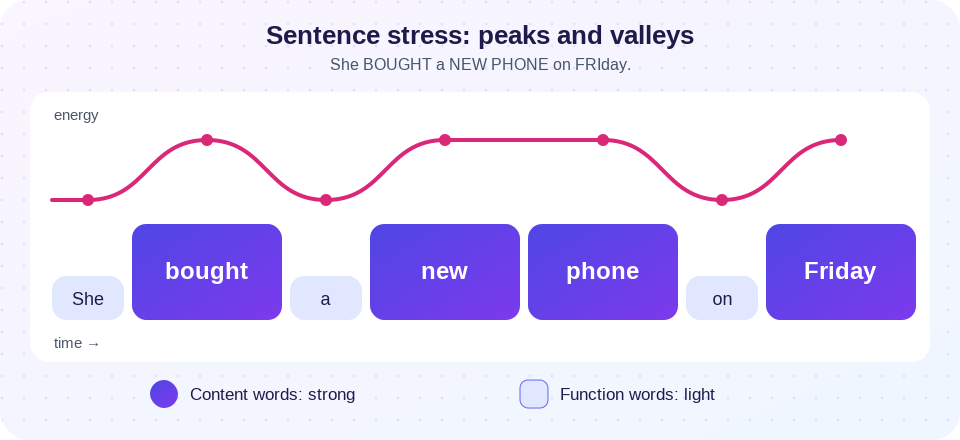
- She bought a new phone on Friday.
Here "she" is a pronoun, so a more typical version is: She BOUGHT a NEW PHONE on FRIday.
- The DOG is SLEEPing under the TAble.
- WHERE did you PARK the CAR?
- I CAN'T FIND my KEYS.
- We USUally EAT at HOME.
The stressed words still follow their own word stress. In "FRIday", only the first syllable carries the beat. Review two-syllable word stress if that is unclear.
Be careful with helping verbs. In "I CAN swim", "can" is normally weak: /kən/. In "I CAN'T swim", the negative is normally stressed and its vowel is full. This stress difference often helps listeners more than the final /t/, which can be very soft.
The main stress
A group of words said together, often between small pauses, is a thought group (also called an intonation unit). Inside each group, one stressed syllable is more prominent than the rest. Linguists often call it the nucleus or tonic syllable. The pitch moves clearly on it.
In neutral speech, the nucleus usually falls on the last content word of the group.
- I'd like a CUP of TEA. (main stress on TEA)
- He works at a HOSpital. (main stress on HOS)
- We're going to the PARK. (main stress on PARK)
There are common cases where the last content word is not the peak. In "The PHONE rang" the stress can fall on "phone" when the whole event is new. In "I have a meeting to ATTEND" or "I have MEETings to attend", speakers choose by meaning. Time words at the end are sometimes lighter too: "I saw him YESterday" may carry its peak on "saw" if the time is not important. These patterns depend on context, so listen to real speakers.
Longer sentences
Long sentences break into thought groups, each with its own main peak.
When I got HOME, | I made some SOUP, | and watched a FILM.
Pause briefly at each bar. Each group has one clear peak. Too many equally strong words make a sentence sound like a list, and very flat speech can make it hard to find the point.
How to mark a sentence
- Underline the content words.
- Mark the stressed syllable in each one.
- Choose the main stress in each thought group.
- Say only the stressed words first: "BOUGHT, NEW, PHONE, FRIday".
- Add the small words back, keeping them light.
Step four is a useful check. The message should make rough sense from the stressed words alone.
A worked example
Take the sentence "I'm going to meet my sister at the museum tomorrow."
- Content words: going, meet, sister, museum, tomorrow.
- In normal speech, "going to" here shows a future plan, so "going" is often light, and "meet" takes more weight.
- A likely pattern: I'm going to MEET my SISter at the muSEum toMORrow.
- If the listener already knows the plan is for tomorrow, the main peak may sit on "muSEum".
There is more than one natural reading. Your goal is not a perfect score but a pattern that matches your meaning.
Common mistakes
- Giving every word the same force, so the important ideas disappear.
- Stressing "a", "the" or "of" without a reason.
- Weakening negatives such as "not" and "can't".
- Forgetting the word stress inside a stressed word.
Try it
Tap the words that you would normally stress in a neutral reading.
Check your understanding
Quick check · 4 questions
of 4 answered You scored / 4 · perfect!
-
1. Which are usually stressed?
These carry most of the meaning. -
2. In neutral speech, where does the main stress usually fall?
This is a common default that context can change. -
3. What is the nucleus?
The pitch moves clearly on this syllable. -
4. How is "can" usually said in "I can swim"?
Positive helping "can" is normally weak.
Summary
- Content words usually carry stress; function words are usually light.
- Negatives and question words are often strong.
- Each thought group has one main peak, often on the last content word.
- Context can change the pattern.
- Practice by saying the stressed words alone and then adding the rest.
Suivez votre progression
Créez un compte gratuit pour cocher vos leçons et reprendre où vous vous étiez arrêté, sur n'importe quel appareil.