
























Lección 32 · Daily Life and Travel
Food and Ordering in a Café
Order food and drinks in Russian with essential cafe phrases, food vocabulary, polite requests, allergy sentences and a realistic practice dialogue.
Ordering a drink is often the first real conversation a learner has. The phrases are short and predictable, so you can prepare well. This lesson also puts your cases to work.
What you will learn
- Basic food and drink words
- Three polite ways to order
- How to say what you do not eat
- How to ask for the bill
Food and drink
| Russian | Meaning | Gender |
|---|---|---|
| вода́ | water | feminine |
| чай | tea | masculine |
| ко́фе | coffee | usually masculine |
| сок | juice | masculine |
| молоко́ | milk | neuter |
| хлеб | bread | masculine |
| суп | soup | masculine |
| сала́т | salad | masculine |
| мя́со | meat | neuter |
| ры́ба | fish | feminine |
| ку́рица | chicken | feminine |
| рис | rice | masculine |
| сыр | cheese | masculine |
| яйцо́ | egg | neuter |
| са́хар | sugar | masculine |
You may see борщ (beet soup), блины́ (thin pancakes) and пельме́ни (a kind of dumpling) on menus. Recipes vary, so ask about ingredients.
Meals
За́втрак is breakfast, обе́д is lunch (the main midday meal) and у́жин is dinner. The verbs are за́втракать, обе́дать and у́жинать.
In the café
| Russian | Meaning |
|---|---|
| меню́ | menu |
| официа́нт | waiter |
| счёт | bill |
| стол на двои́х | a table for two |
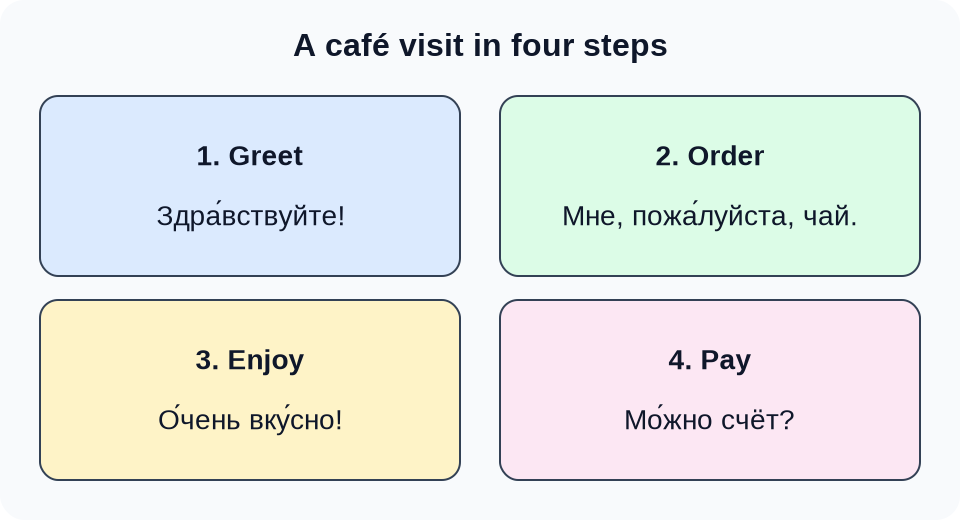
| Мо́жно меню́, пожа́луйста? | May I have the menu, please? |
Three ways to order
All three take the accusative, so feminine words in -а change to -у.
- Мне, пожа́луйста, ... Мне, пожа́луйста, во́ду. (Water for me, please.)
- Мо́жно ...? Мо́жно сала́т и ры́бу? (May I have a salad and fish?)
- Я бу́ду ... Я бу́ду суп. (I'll have the soup.)
You will also hear Да́йте, пожа́луйста, ... (Please give me ...). With пожа́луйста it is a normal request.
| Nominative | In your order |
|---|---|
| суп | суп |
| вода́ | во́ду |
| ры́ба | ры́бу |
| ку́рица | ку́рицу |
| сок | сок |
With and without
Без takes the genitive. С meaning "with" takes the instrumental. Learn these as ready phrases.
| Without | With |
|---|---|
| без са́хара (without sugar) | с са́харом (with sugar) |
| без молока́ (without milk) | с молоко́м (with milk) |
| без мя́са (without meat) | с мя́сом (with meat) |
| без льда (without ice) | со льдом (with ice) |
Diet and allergies
| Russian | Meaning |
|---|---|
| Я не ем мя́со. | I don't eat meat. |
| Я вегетариа́нец. / Я вегетариа́нка. | I am a vegetarian. (man / woman) |
| У меня́ аллерги́я на оре́хи. | I have a nut allergy. |
| Здесь есть оре́хи? | Are there nuts in this? |
| Из чего́ э́то? | What is this made of? |
If you have a serious allergy, do not rely only on a spoken phrase. Carry a written note checked by a fluent speaker, and confirm the answer before you eat.
Paying
| Russian | Meaning |
|---|---|
| Мо́жно счёт, пожа́луйста? | May I have the bill, please? |
| Мо́жно оплати́ть ка́ртой? | May I pay by card? |
| нали́чными | in cash |
| Вме́сте и́ли отде́льно? | Together or separately? |
Tipping habits and accepted payment methods differ by place and change over time. Check before you go.
A sample dialogue
| Speaker | Russian | Meaning |
|---|---|---|
| Waiter | Здра́вствуйте! Что вы бу́дете? | Hello! What will you have? |
| You | Мне, пожа́луйста, суп и чай. | Soup and tea for me, please. |
| Waiter | Чай с са́харом? | Tea with sugar? |
| You | Нет, без са́хара. | No, without sugar. |
| Waiter | Что-нибу́дь ещё? | Anything else? |
| You | Нет, спаси́бо. | No, thank you. |
| Waiter | Прия́тного аппети́та! | Enjoy your meal! |
To say that you liked it: О́чень вку́сно, спаси́бо! (Very tasty, thank you!)
Worked example: build your order
Start with what you want: a salad, fish and water without ice.
- Choose a polite frame: Мне, пожа́луйста, ...
- Put each food in the accusative. Сала́т stays the same. Ры́ба becomes ры́бу. Вода́ becomes во́ду.
- Add the extra detail with the genitive: без льда.
- The full order: Мне, пожа́луйста, сала́т, ры́бу и во́ду без льда.
Now change the order to chicken, rice and coffee with milk: Мне, пожа́луйста, ку́рицу, рис и ко́фе с молоко́м.
Phrases you may hear
Staff often speak quickly. It helps to recognize these.
| Russian | Meaning |
|---|---|
| Вы гото́вы сде́лать зака́з? | Are you ready to order? |
| Что бу́дете пить? | What will you drink? |
| К сожале́нию, э́того нет. | Unfortunately, we don't have that. |
| Здесь и́ли с собо́й? | For here or to go? |
| Мину́точку. | Just a moment. |
For takeaway, you can say с собо́й, пожа́луйста (to go, please).
Likes and dislikes
Use what you learned about verbs to talk about food. Я люблю́ сыр. (I love cheese.) Я не люблю́ ры́бу. (I don't like fish.) Я хочу́ есть. (I'm hungry, literally "I want to eat".) Я хочу́ пить. (I'm thirsty.) Write four sentences about your own taste, and check that every feminine object ends in -у or -ю.
Practice on your own
Imagine that a waiter is waiting for your answer.
| Say this in Russian | One good answer |
|---|---|
| A tea with lemon, please. | Мне, пожа́луйста, чай с лимо́ном. |
| May I have soup and bread? | Мо́жно суп и хлеб? |
| I'll have the chicken. | Я бу́ду ку́рицу. |
| Without cheese, please. | Без сы́ра, пожа́луйста. |
The word лимо́н means lemon. After this с, it takes the instrumental form: с лимо́ном.
Common mistakes
- Ordering with "во́да". After Мне, пожа́луйста, say во́ду.
- Saying "без са́хар". Say без са́хара.
- Using ты with staff you do not know. Use вы.
- Mixing up есть (to eat) with пить (to drink).
Try it
Check your understanding
Quick check · 4 questions
of 4 answered You scored / 4 · perfect!
-
1. Which is the correct order for fish?
The thing you order takes the accusative. -
2. What does "без льда" mean?
Без means without. Льда is the genitive of лёд (ice). -
3. What does "Мо́жно счёт?" ask for?
Счёт is the bill. -
4. How would a woman say "I am a vegetarian"?
Вегетарианка is the feminine form.
Summary
- Order with Мне, пожалуйста, with Можно, or with Я буду.
- The item you order is in the accusative.
- Без takes the genitive.
- Check allergy information carefully.
- Ask for the bill with Можно счёт, пожалуйста?
Next: Shopping in Russian
Sigue tu progreso
Crea una cuenta gratis para marcar lecciones y retomar donde lo dejaste en cualquier dispositivo.