
























Lección 19 · Scales and Technique
The Major Scale Pattern on the Piano
Learn the whole step and half step pattern behind every major scale, then build C, G and F major on the piano keyboard from any starting note.
A scale is a row of notes in order, going up or down by small steps. The major scale is the best one to learn first. Many songs and classical pieces are built from it, and it helps you understand keys and chords later.
You do not need to memorize each major scale as a separate list. All of them follow one pattern of distances. When you know the pattern, you can build a major scale from any key.
What you will learn
- What a half step and a whole step are on the keyboard
- The major scale pattern
- How to build C, G and F major
- Why some scales need black keys
- A way to practice that trains your ear too
Half steps and whole steps
A half step (also called a semitone) is the distance from one key to the very next key. Count black and white keys together. From C to C sharp is a half step. From E to F is also a half step, because there is no black key between them.
A whole step (or tone) equals two half steps. From C to D is a whole step, because C sharp sits between them. From E to F sharp is a whole step too, even though one key is white and one is black.
So the color of a key tells you nothing about distance. Only the number of keys does.
| From | To | Distance |
|---|---|---|
| C | C sharp | half step |
| E | F | half step |
| B | C | half step |
| C | D | whole step |
| B flat | C | whole step |
The pattern
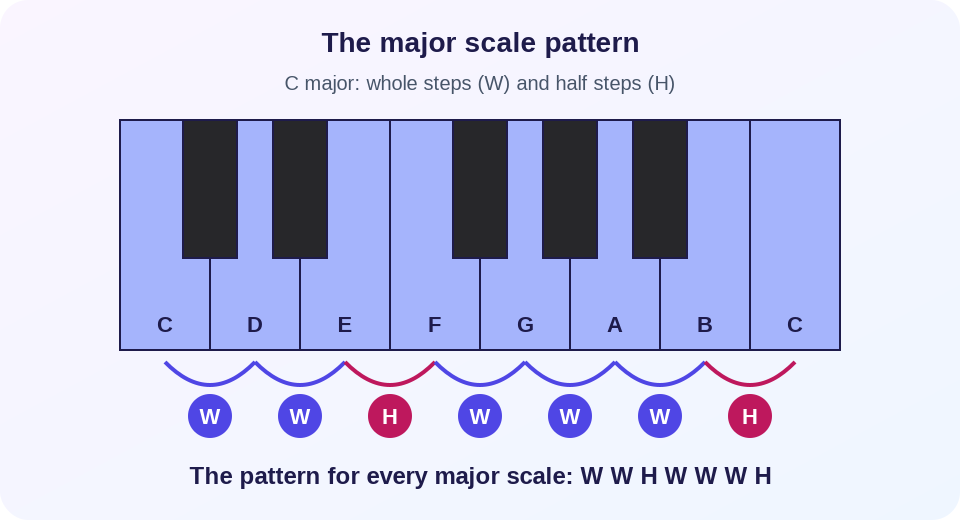
Starting from the first note, a major scale moves like this, where W means whole step and H means half step:
W, W, H, W, W, W, H
Seven steps take you through eight notes. The eighth note has the same letter name as the first one. It sounds higher, and the distance between these two notes is called an octave.
The notes are often numbered 1 to 7. These numbers are called scale degrees. Degree 1 is the tonic, the home note. Degree 5 is the dominant, and degree 4 is the subdominant. Half steps fall between degrees 3 and 4, and between degrees 7 and 8. Do not confuse scale degrees with finger numbers. They are two different systems.
Building C major
Start on C and follow the pattern.
- C up a whole step is D.
- D up a whole step is E.
- E up a half step is F.
- F up a whole step is G.
- G up a whole step is A.
- A up a whole step is B.
- B up a half step is C.
The result is C D E F G A B C. It uses only white keys, which is why beginners usually meet it first.
Building G major
Now start on G. The first six notes are G, A, B, C, D and E, all white keys. The next move must be a whole step. A whole step above E is F sharp, not F. Then a half step takes you from F sharp up to G.
G major is G A B C D E F sharp G. The one black key is not decoration. Without it, the pattern breaks, and the scale no longer sounds major.
Building F major
Start on F. F to G is a whole step. G to A is a whole step. Then you need a half step. The key just above A is the black key between A and B. In this scale you call it B flat.
F major is F G A B flat C D E F. Why not call that key A sharp? A major scale uses each letter name once, in order. The scale already has an A, so the fourth note must be some kind of B.
When you write a major scale, first write the eight letters in order. Then add sharps or flats until the pattern of steps is correct. You will never skip or repeat a letter.
The sharps or flats that a scale needs form its key signature. C major has none, G major has one sharp (F sharp), and F major has one flat (B flat). In printed music, the key signature appears at the start of each line.
Listening while you practice
Play C major slowly with any comfortable fingers for now. The next lesson gives you the standard fingering. Sing or hum along if you like. Stop on the seventh note, B. Many listeners feel that it wants to move on to C. Then play it and notice how the scale sounds finished.
Next, play the same scale but use F sharp instead of F. It sounds different. Changing one note changes the character of the whole row.
Common mistakes
- Counting only white keys as steps. Black keys always count.
- Playing F natural in G major, or B natural in F major.
- Using the same letter twice, such as A and A sharp, when you spell a major scale.
- Rushing the easy notes and slowing down at the black keys.
Try it
Press a button, then step through each scale one note at a time. Before each click, guess the next key.
Now check your understanding of the steps.
Check your understanding
Quick check · 4 questions
of 4 answered You scored / 4 · perfect!
-
1. What is the major scale pattern, using W for whole step and H for half step?
Half steps come between degrees 3 and 4 and between degrees 7 and 8. -
2. Which note does G major need that C major does not have?
The sixth step of the pattern must be a whole step from E, which gives F sharp. -
3. Why is the fourth note of F major called B flat and not A sharp?
On a piano the two names point to the same key, but the spelling of a major scale uses each letter once. -
4. How far apart are two keys that are right next to each other, counting black and white keys?
Neighboring keys are one half step apart.
Summary
- A half step is the next key; a whole step is two half steps.
- Every major scale follows W W H W W W H.
- C major has no sharps or flats, G major has F sharp, and F major has B flat.
- Spell a major scale with each letter once, in order.
Sigue tu progreso
Crea una cuenta gratis para marcar lecciones y retomar donde lo dejaste en cualquier dispositivo.