
























Lección 29 · Daily Life
Ordering Food and Drinks
Order food and drinks in Korean: call staff, say what you want, ask about spice and ingredients, mention allergies and ask for the bill.
Food is one of the most enjoyable reasons to learn Korean. With a few short phrases, you can order in a restaurant or a cafe and understand the most common questions.
This lesson follows a visit from start to finish: arriving, ordering, asking questions and paying.
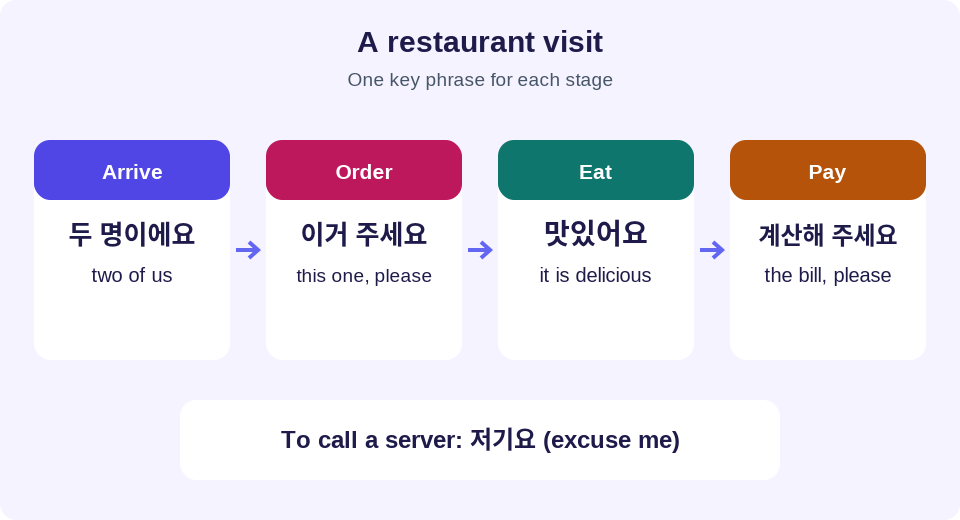
What you will learn
- Common food and drink words
- How to order with 주세요
- Questions you may hear from staff
- How to talk about spice, ingredients and allergies
Food and drink words
| Korean | Romanization | Meaning |
|---|---|---|
| 밥 | bap | cooked rice, meal |
| 물 | mul | water |
| 커피 | keopi | coffee |
| 차 | cha | tea |
| 우유 | uyu | milk |
| 빵 | ppang | bread |
| 고기 | gogi | meat |
| 생선 | saengseon | fish (as food) |
| 야채 | yachae | vegetables |
| 계란 | gyeran | egg |
| 김치 | gimchi | kimchi |
| 비빔밥 | bibimbap | mixed rice with toppings |
| 김밥 | gimbap | seaweed rice rolls |
| 불고기 | bulgogi | marinated grilled meat |
| 떡볶이 | tteokbokki | rice cakes in sauce |
| 라면 | ramyeon | ramen noodles |
Arriving
Staff often greet guests with 어서 오세요 (eoseo oseyo), "welcome". Then they may ask:
- 몇 분이세요? (How many in your group?)
Answer with a native number and 명: 한 명이에요, 두 명이에요, 세 명이에요.
To call a server, say 저기요 (jeogiyo). It means something like "excuse me". Some tables have a call button instead.
Ordering
- 메뉴 좀 주세요. (Menyu jom juseyo.) The menu, please.
- 이거 주세요. (Igeo juseyo.) This one, please. Point at the item.
- 비빔밥 하나 주세요. (One bibimbap, please.)
- 불고기 이 인분 주세요. (Two servings of bulgogi, please.)
- 커피 두 잔 주세요. (Two coffees, please.)
좀 (jom) softens a request. 인분 (inbun) means "servings" and takes Sino-Korean numbers. For dishes, people often say 하나 or 두 개 after the dish name.
Asking for advice
- 뭐가 맛있어요? (Mwoga masisseoyo?) What is tasty here?
- 추천해 주세요. (Chucheonhae juseyo.) Please recommend something.
- 이거 매워요? (Igeo maewoyo?) Is this spicy?
- 안 맵게 해 주세요. (An maepge hae juseyo.) Please make it not spicy.
Not every dish can be changed. If staff say 안 돼요, it means that it is not possible.
Ingredients and diet
| Korean | Meaning |
|---|---|
| 이거 고기 들어가요? | Does this contain meat? |
| 저는 고기를 안 먹어요. | I do not eat meat. |
| 빼 주세요. | Please leave it out. |
| 계란은 빼 주세요. | Please leave out the egg. |
| 땅콩 알레르기가 있어요. | I have a peanut allergy. |
땅콩 (ttangkong) means peanut and 알레르기 (allereugi) means allergy.
A language phrase cannot guarantee food safety. Sauces and broths may contain ingredients that you cannot see, including fish or meat. If you have a serious allergy, carry a clear written note, follow your doctor's advice and do not eat food if you are unsure.
In a cafe
- 아이스 아메리카노 한 잔 주세요. (One iced americano, please.)
- 따뜻한 차 주세요. (Warm tea, please.)
- 여기서 먹을 거예요. (I will have it here.)
- 포장해 주세요. (To go, please.)
Staff may ask 드시고 가세요? (Will you eat or drink here?) or 가져가세요? (Are you taking it with you?).
During and after the meal
- 물 좀 더 주세요. (A little more water, please.)
- 맛있어요. (It is delicious.)
- 잘 먹겠습니다. (Said before eating, with thanks.)
- 잘 먹었습니다. (Said after eating, with thanks.)
- 계산해 주세요. (The bill, please.)
In many restaurants, you pay at a counter near the door. In others, you may order and pay at a screen. Watch what other guests do.
A short dialogue
- Staff: 어서 오세요. 몇 분이세요? (Welcome. How many?)
- You: 두 명이에요. (Two.)
- Staff: 주문하시겠어요? (Are you ready to order?)
- You: 네. 김밥 하나하고 라면 하나 주세요. (Yes. One gimbap and one ramen, please.)
- Staff: 네, 잠시만 기다려 주세요. (Yes, please wait a moment.)
하고 (hago) means "and" between nouns.
At the table
Customs differ from place to place. Many restaurants serve small side dishes, called 반찬 (banchan), with the meal. You may hear 더 드릴까요? which means "Shall I give you more?" You can answer 네, 주세요 or 괜찮아요.
In some places you get water or utensils yourself. Look for a self-service sign or a drawer at your table, and watch what other guests do. The word 셀프 (selpeu) on a sign usually means that you serve yourself.
Useful words at the table:
| Korean | Meaning |
|---|---|
| 숟가락 | spoon |
| 젓가락 | chopsticks |
| 접시 | plate |
| 휴지 | tissue |
To ask for one, add 주세요: 젓가락 주세요. If you need an extra one, say 하나 더 주세요 (one more, please). With these few phrases, you can handle many small needs during a meal without switching to another language.
Rehearse before you go
Before you visit a restaurant, plan your order in Korean. Choose one dish and one drink. Write both sentences and say them three times. Then prepare for the questions you are likely to hear: how many people, and whether you will eat there or take the food away.
If the answer you hear is different from what you expected, do not panic. Say 다시 한번 말해 주세요 and listen for words you know, such as numbers, 네 or 안 돼요. You can also point at the menu. Many menus have pictures, which helps both you and the staff.
Common mistakes
- Saying 저 for "this one" when the item is in your hand or under your finger. Say 이거.
- Mixing up 맵다 (spicy) and 맛있다 (tasty).
- Assuming a dish without visible meat has no meat in the broth. Ask.
- Saying 한 개 for a drink in a cafe when 한 잔 is more natural.
Try it
Check your understanding
Quick check · 4 questions
of 4 answered You scored / 4 · perfect!
-
1. How do you call a server politely?
저기요 is a common way to get attention. -
2. What does 포장해 주세요 mean?
포장 means packing the food to take away. -
3. Staff ask 몇 분이세요? What do they want to know?
분 is a respectful counter for people here. -
4. Which sentence says you have a peanut allergy?
알레르기가 있어요 means I have an allergy.
Summary
- Use 저기요 to get attention and 이거 주세요 to order by pointing.
- Use 주세요 with a number and counter to order amounts.
- Ask about spice and ingredients, and be careful with allergies.
- 포장해 주세요 means "to go", and 계산해 주세요 asks to pay.
Next: Shopping and Prices
Sigue tu progreso
Crea una cuenta gratis para marcar lecciones y retomar donde lo dejaste en cualquier dispositivo.