Understand the three parts of the IELTS Speaking interview, their timings, the four marking criteria and sensible ways to practice at home.
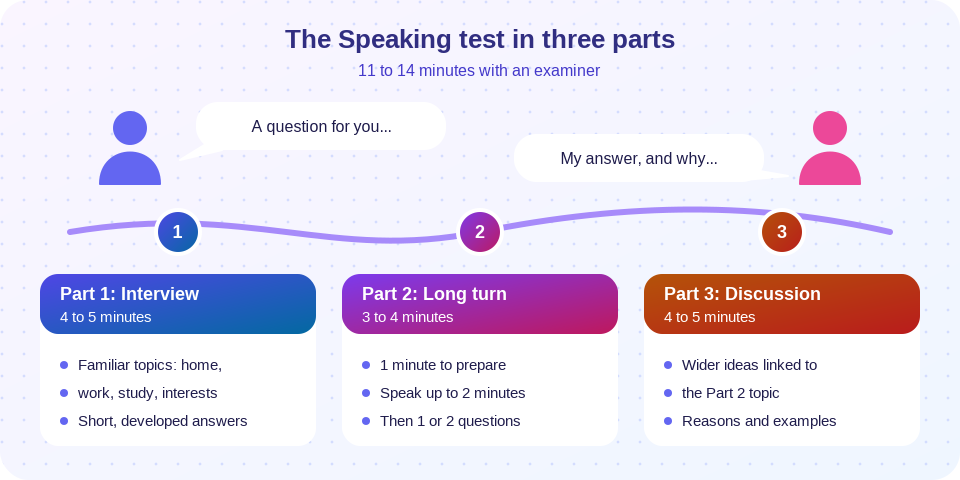
The Speaking test is a conversation with a trained examiner. According to the official site, it lasts 11 to 14 minutes, it is recorded, and it has three parts. The Speaking test is the same for Academic and General Training. Check ielts.org for how it is arranged at your test centre, including when your interview will take place. This tutorial is independent, and every prompt in it is original.
Each part asks for a slightly different kind of talk, from short answers to a longer discussion.
The official site lists four equally weighted areas.
Criterion
What it means in simple words
Practice idea
Fluency and coherence
Speaking at a steady pace with ideas that connect
Talk for one minute without stopping to restart sentences
Lexical resource
Choosing words with range and accuracy
Paraphrase a word you do not know
Grammatical range and accuracy
Using varied structures with few errors
Tell one story using past, present and future
Pronunciation
Being clear and easy to understand
Practice word stress and sentence stress
Pronunciation is not about sounding like a speaker from one country. You can keep your accent. The aim is to be understood, with clear sounds, stress and rhythm.
The examiner is judging your language, not your opinions or your knowledge of a subject. You do not need to be an expert on any topic. If a question is about something you rarely think about, you can say so and still talk: "I haven't thought much about it, but I suppose..." Then give a reason.
Fluency does not mean speed. Many strong speakers pause, but they pause in natural places, for example between ideas. Useful ways to buy a second of thinking time include:
"That's an interesting question."
"Let me think for a moment."
"It depends on the situation, really."
Use these sometimes, not before every answer. Repeating the same filler makes it noticeable.
Short, frequent practice usually beats one long session before the test. Here is a pattern that you can adjust.
Day
Task
Focus
Day 1
Five Part 1 questions, answered aloud
Direct answers with one detail
Day 2
One Part 2 card with the timer
Keeping going
Day 3
Four Part 3 questions
Reasons and examples
Day 4
Replay one recording and repeat it
Fixing two errors
If speaking alone feels strange, talk to an imagined listener and look up from your notes. What matters is that your mouth practices whole sentences. Silent reading builds knowledge, but it does not train the speed that you need to find words while talking. Keep one page of phrases that you actually used well, and remove any that never come out naturally.
Sort situations into the correct part of the test, then run a timed rehearsal. Speak aloud while the clock runs. The page does not listen to you.
Which part is it?
<style>body{font-family:system-ui,sans-serif;margin:0;padding:14px;color:#1e1b4b;background:linear-gradient(135deg,#faf5ff,#eff6ff)}.card{background:#fff;border-radius:14px;padding:12px 14px;margin:0 0 10px;box-shadow:0 6px 18px rgba(67,56,202,.12)}button{font:inherit;font-weight:600;border:0;border-radius:999px;padding:8px 16px;margin:3px 4px 3px 0;color:#fff;background:linear-gradient(135deg,#4f46e5,#be185d);cursor:pointer}button.alt{background:#e0e7ff;color:#312e81}select,input,textarea{font:inherit;border:2px solid #c7d2fe;border-radius:10px;padding:6px 8px;background:#fff;color:#1e1b4b;max-width:100%;box-sizing:border-box}input[type=checkbox]{width:auto}textarea{width:100%;min-height:130px}.ok{color:#047857;font-weight:600}.no{color:#b91c1c;font-weight:600}.big{font-size:40px;font-weight:700;text-align:center;color:#4f46e5}.bar{height:12px;border-radius:99px;background:#e0e7ff;overflow:hidden}.bar i{display:block;height:100%;width:0;background:linear-gradient(90deg,#14b8a6,#6366f1)}</style><divid="list"></div><buttonid="check">Check answers</button><pid="score"></p><script>const items =[["\"Do you enjoy cooking at home?\"",["Part 1","Part 2","Part 3"],0,"It is a short, personal, familiar question."],["A card asks you to describe a place that you like to visit, and you get one minute to prepare.",["Part 1","Part 2","Part 3"],1,"A card and preparation time signal the long turn."],["\"How might the way people spend free time change in the future?\"",["Part 1","Part 2","Part 3"],2,"It is broad and abstract."],["\"What do you usually do in the evenings?\"",["Part 1","Part 2","Part 3"],0,"It is about your daily life."]];const list = document.getElementById('list');
items.forEach((item, i)=>{const box = document.createElement('div');
box.className ='card';const p = document.createElement('p');
p.textContent =(i +1)+'. '+ item[0];const sel = document.createElement('select');
sel.id ='s'+ i;
sel.add(newOption('Choose...','-1'));
item[1].forEach((text, n)=> sel.add(newOption(text,String(n))));const out = document.createElement('div');
out.id ='o'+ i;
box.append(p, sel, out);
list.append(box);});
document.getElementById('check').onclick=()=>{let right =0;
items.forEach((item, i)=>{const ok =Number(document.getElementById('s'+ i).value)=== item[2];if(ok) right++;const out = document.getElementById('o'+ i);
out.className = ok ?'ok':'no';
out.textContent = ok ?'Matches the key. '+ item[3]:'Not the key answer. Hint: '+ item[3];});
document.getElementById('score').textContent = right +' of '+ items.length +' match the answer key.';};</script>
Speaking practice clock
<style>body{font-family:system-ui,sans-serif;margin:0;padding:14px;color:#1e1b4b;background:linear-gradient(135deg,#faf5ff,#eff6ff)}.card{background:#fff;border-radius:14px;padding:12px 14px;margin:0 0 10px;box-shadow:0 6px 18px rgba(67,56,202,.12)}button{font:inherit;font-weight:600;border:0;border-radius:999px;padding:8px 16px;margin:3px 4px 3px 0;color:#fff;background:linear-gradient(135deg,#4f46e5,#be185d);cursor:pointer}button.alt{background:#e0e7ff;color:#312e81}select,input,textarea{font:inherit;border:2px solid #c7d2fe;border-radius:10px;padding:6px 8px;background:#fff;color:#1e1b4b;max-width:100%;box-sizing:border-box}input[type=checkbox]{width:auto}textarea{width:100%;min-height:130px}.ok{color:#047857;font-weight:600}.no{color:#b91c1c;font-weight:600}.big{font-size:40px;font-weight:700;text-align:center;color:#4f46e5}.bar{height:12px;border-radius:99px;background:#e0e7ff;overflow:hidden}.bar i{display:block;height:100%;width:0;background:linear-gradient(90deg,#14b8a6,#6366f1)}</style><divclass="card"><pid="prompt"style="white-space:pre-line"></p></div><divclass="card"><divid="stage"></div><divclass="big"id="clock"></div><divclass="bar"><iid="fill"></i></div></div><buttonid="start">Start</button><buttonid="stop"class="alt">Reset</button><buttonid="other"class="alt">Another prompt</button><script>const prompts =["Talk about your daily routine. What is your favorite part of the day, and why?","Describe a small habit that you would like to start. Explain why.","Do people in general have too little free time? Give reasons."];const stages =[["Think quietly",15],["Speak aloud",60]];let p =0, s =0, left = stages[0][1], handle =null;constel=id=> document.getElementById(id);functiondraw(){el('prompt').textContent = prompts[p];el('stage').textContent = s < stages.length ? stages[s][0]:'Time is up. Note one thing to improve.';el('clock').textContent = Math.floor(left /60)+':'+String(left %60).padStart(2,'0');el('fill').style.width =(s < stages.length ?100*(1- left / stages[s][1]):100)+'%';}functionstop(){clearInterval(handle); handle =null;}functiontick(){
left--;if(left <=0){
s++;if(s < stages.length){ left = stages[s][1];}else{ left =0;stop();}}draw();}functionreset(){stop(); s =0; left = stages[0][1];draw();}el('start').onclick=()=>{if(s >= stages.length){reset();}if(!handle){ handle =setInterval(tick,1000);}};el('stop').onclick = reset;el('other').onclick=()=>{ p =(p +1)% prompts.length;reset();};draw();</script>