
























Lección 14 · Perspective
Perspective Basics: Horizon and Eye Level
Understand linear perspective: the horizon line, your eye level, vanishing points and why things look smaller and closer together far away.
Stand on a long straight road or look down a long hallway. The edges seem to draw closer as they go away. Lamp posts that are the same height look smaller and smaller. Linear perspective is a system for showing these effects on a flat page.
You do not need advanced math. A few ideas explain a great deal.
What you will learn
- What the horizon line and eye level mean
- What a vanishing point is
- Which lines converge and which do not
- How eye level changes what you can see
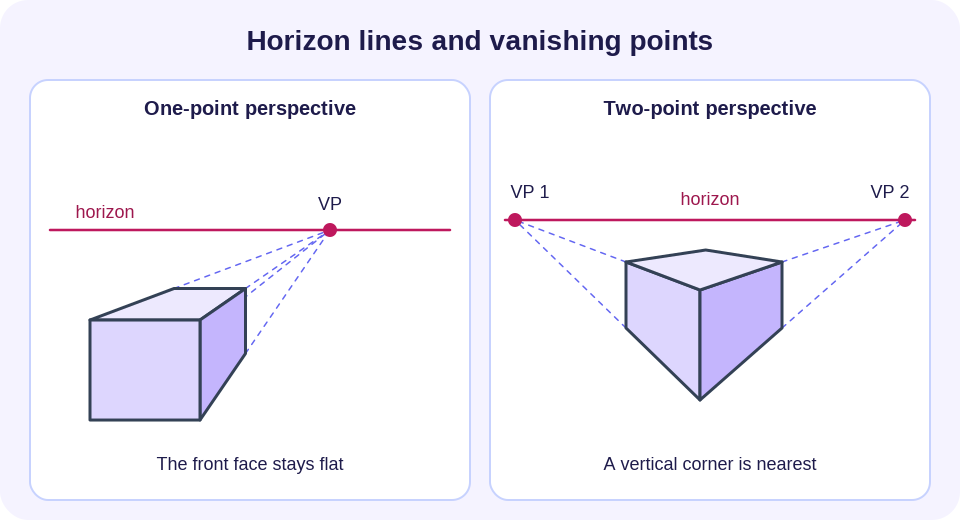
Size and distance
Objects of the same size look smaller when they are farther away. Spaces between evenly spaced things also look smaller with distance. A row of equal fence posts looks tighter toward the back.
Eye level and the horizon
Eye level is the height of your eyes as you look out. The horizon line in your drawing is a flat line that represents your eye level.
Outdoors by a calm sea, with your view level, the visible horizon of the water appears very close to your eye level. Indoors you may not see a real horizon at all, but you still have an eye level, and you can draw it as a horizon line.
If you crouch, your eye level drops. If you climb stairs, it rises. The horizon line moves with you.
What eye level shows you
For level, flat surfaces such as table tops:
| Position of a flat surface | What you see |
|---|---|
| Below eye level | The top side |
| At eye level | Only a thin edge, like a line |
| Above eye level | The underside |
A useful check: if your friend is the same height as you and stands on flat ground at some distance, their eyes tend to sit near the horizon line, wherever they are on the ground. A shorter child's eyes would sit below it.
Vanishing points
A vanishing point is a point where lines that are parallel in real space appear to meet on the page.
A key rule:
Sets of level, parallel lines that go into the distance converge at a point on the horizon line.
So the two edges of a straight, flat road, the tops of walls along a level hallway and the lines of floorboards all aim at a point on the horizon, as long as they run in the same direction.
Each different direction has its own vanishing point. A table turned at an angle uses different points from a table placed square to the room.
Lines that do not converge toward the horizon
Some lines behave differently:
- Lines parallel to your picture plane, such as flat edges that run straight across your view, stay flat and do not meet at a vanishing point.
- In one and two-point perspective, vertical edges are drawn vertical.
- Lines on slopes, such as a ramp or a roof, aim at vanishing points above or below the horizon.
The picture plane is an imaginary window between you and the scene, on which the scene is drawn. In ordinary drawing, you look straight ahead through it.
One, two and three points
Names such as one-point, two-point and three-point describe how many main vanishing points a simple box-like setup uses:
- One-point: one face points straight at you.
- Two-point: a vertical edge is closest to you and two sides recede.
- Three-point: you look up or down, so vertical edges also converge.
These are names for common situations, not different laws. One scene can use many vanishing points at once if objects face different directions.
How to find your eye level
- Hold your pencil flat at the height of your eyes, at arm's length.
- Notice which point in the room it covers.
- Everything behind your pencil at that height is at your eye level.
- Draw that as your horizon line before anything else.
Distance between vanishing points
If you place two vanishing points very close together on a page, boxes can look badly distorted, as if seen through a very wide lens. Spreading them farther apart often looks more natural. It is fine for a vanishing point to be outside your paper. You can tape extra paper at the sides, or estimate the direction.
A quick room check
Sit down and look straight ahead at a wall. Find a line where the wall meets the ceiling that runs away from you, along a side wall. It slopes down toward your eye level. The matching floor line slopes up. Now stand up and look again. Your eye level has risen, so the slopes have changed. The floor line may look steeper and the ceiling line flatter. This simple experiment shows that the horizon belongs to you, the viewer, and not to the room.
Common mistakes
- Placing the horizon line anywhere without linking it to your eye level.
- Making all lines converge to one point, even lines that face different directions.
- Putting two vanishing points so close that boxes look warped.
- Changing your viewpoint partway through the drawing.
Try it
Slide the horizon up and down and watch the box. When the horizon is above the box, you see its top. When it is below, you see its underside.
Check your understanding
Quick check · 4 questions
of 4 answered You scored / 4 · perfect!
-
1. What does the horizon line in a perspective drawing represent?
The horizon line marks eye level. -
2. Where do level parallel lines that recede usually appear to meet?
Level receding parallels converge on the horizon. -
3. You see the underside of a flat shelf. Where is it?
Surfaces above your eyes show their undersides. -
4. Can a vanishing point be outside your paper?
Spread-out points often look more natural, even off the page.
Summary
- The horizon line stands for your eye level.
- Level parallel lines that recede meet at vanishing points on the horizon.
- Each direction has its own vanishing point.
- You see the tops of things below eye level and undersides above it.
- Keep your viewpoint fixed while drawing.
Next: One-Point Perspective
Sigue tu progreso
Crea una cuenta gratis para marcar lecciones y retomar donde lo dejaste en cualquier dispositivo.