
























Lección 1 · How Communication Works
Communication Skills Course Map
Start the communication skills course: see the full map from listening and speaking to writing, feedback, conflict and teamwork, and plan how to practice.
Communication is how you turn what is in your head into something another person can understand and use. You do it all day: you ask for help, explain a delay, answer a message, or disagree with a friend. Small improvements add up, because you repeat these actions many times.
This course treats communication as a set of skills that you can practice. It is not a personality type. Quiet people can be excellent communicators, and confident talkers can be hard to understand. What matters is whether the other person gets the meaning, and whether the relationship stays healthy.
You can follow this course if you are a student, a new employee, an experienced professional, or someone who is learning English. The language is plain, and the examples come from study, work and daily life.
What you will learn
- What the course covers, chapter by chapter
- What good communication looks like in practice
- How to practice so that a new habit lasts
- How to choose a personal goal for the course
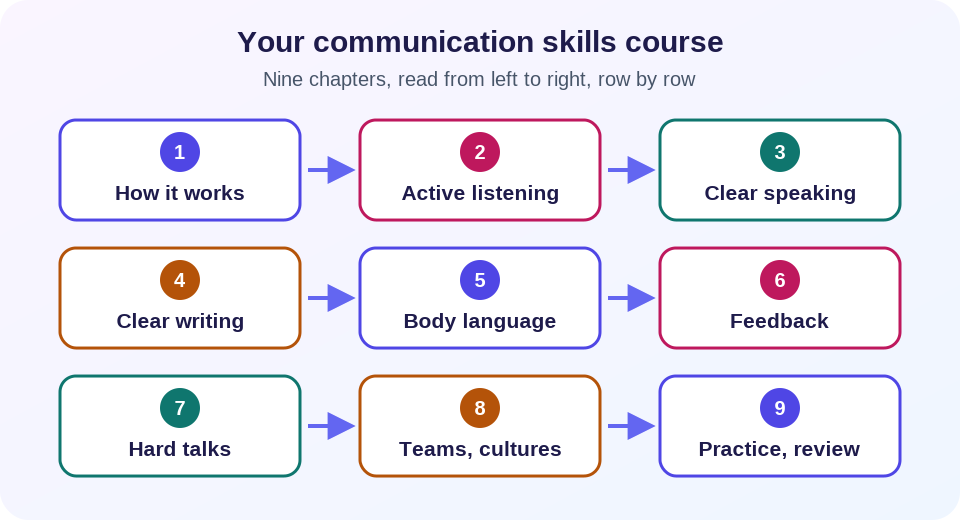
The course at a glance
The first four chapters build your core skills.
- How Communication Works. You study the basic model, the gap between what you mean and what others hear, and how to pick the right channel.
- Active Listening. You learn to give attention, ask useful questions, check your understanding and handle the things that stop you from listening.
- Clear Speaking. You organize a message, use plain words, control your voice and explain difficult ideas.
- Clear Writing at Work. You write messages that people can read quickly and act on.
The later chapters cover nonverbal communication, feedback, difficult conversations and conflict, and teams and cultures. The course ends with practice and review.
You can start with the basic communication model. If you already know it, jump to the chapter you need. Still, the chapters are designed to build on each other.
What "good" looks like
People often think a good communicator speaks smoothly. Smooth speech is pleasant, but it is not the goal. A better test has three questions.
- Was it understood? Could the other person repeat the main point correctly?
- Was it useful? Did they know what to do, decide or feel next?
- Was it respectful? Can you both keep working together afterward?
Look at two versions of the same request. In the first, Samir writes to a coworker: "Any news on the thing?" The coworker does not know which thing, or when an answer is needed. In the second, Samir writes: "Do you have the final price list for the spring catalog? I need it by Thursday noon to send it to the printer." The second message is longer, but it saves time. It names the item, the deadline and the reason.
Neither version is rude. The difference is that the second one does the reader's guessing work for them.
How to practice
Reading about communication will not change much on its own. You need to try things with real people. Use this simple loop.
- Pick one behavior. For example, "I will not interrupt in my Monday meeting."
- Try it in a low-risk moment. A short chat is a safer start than a serious dispute.
- Notice what happened. Did the other person say more? Did you feel an urge to jump in?
- Adjust and repeat. Keep what works. Change one thing at a time.
Keep a small practice log on paper or in a notes app. Write the date, the behavior you tried, what happened and what you will try next. Four short lines are enough.
Feedback from others helps a lot. Ask one trusted person a narrow question, such as "When I explained the schedule, which part was unclear?" A narrow question gets a more useful answer than "Was I good?"
Your starting point
Most people are stronger in some situations than in others. You may explain things well to a friend and freeze in a meeting. You may write careful emails but send rushed chat messages. So do not label yourself as "a bad communicator." Name the situation instead.
A useful goal is specific and observable. "Be better at speaking" is hard to check. "Say my main point in the first two sentences of my weekly update" is easy to check. The first activity below helps you tell the two kinds apart.
A note on cultures and contexts
There is no single correct style for the whole world. Directness, eye contact, silence and humor are read differently in different places, teams and families. This course offers methods that you can adapt. When you are unsure, watch how people around you behave, and ask politely.
Common mistakes
- Trying to change many habits at once. Choose one.
- Judging success only by how you felt. Check what the other person understood.
- Believing that one script works with everyone. Adapt to the person and the setting.
- Waiting to feel confident before practicing. Confidence usually grows after practice.
Try it
Check your understanding
Quick check · 4 questions
of 4 answered You scored / 4 · perfect!
-
1. What is the best sign that a message worked?
Understanding and a clear next step matter more than style or length. -
2. Which practice plan is most likely to build a habit?
One observable behavior with a short feedback loop is easier to keep. -
3. Why was Samir's second message better?
The details meant the reader did not have to guess. -
4. What should you do if you are unsure which style fits a new culture or team?
Norms differ, so observing and asking helps you adapt.
Summary
- Communication is a set of skills you can practice, not a fixed personality.
- A good message is understood, useful and respectful.
- Practice one observable behavior at a time and note the result.
- Name the situation you want to improve instead of labeling yourself.
- Styles differ across cultures and teams, so observe and adapt.
Next: The Communication Model
Sigue tu progreso
Crea una cuenta gratis para marcar lecciones y retomar donde lo dejaste en cualquier dispositivo.