
























Lektion 6 · Reading
TOEFL Reading Overview
Meet the three TOEFL iBT Reading tasks, see what skills each one needs, and learn a calm evidence-first method that works across all of them.
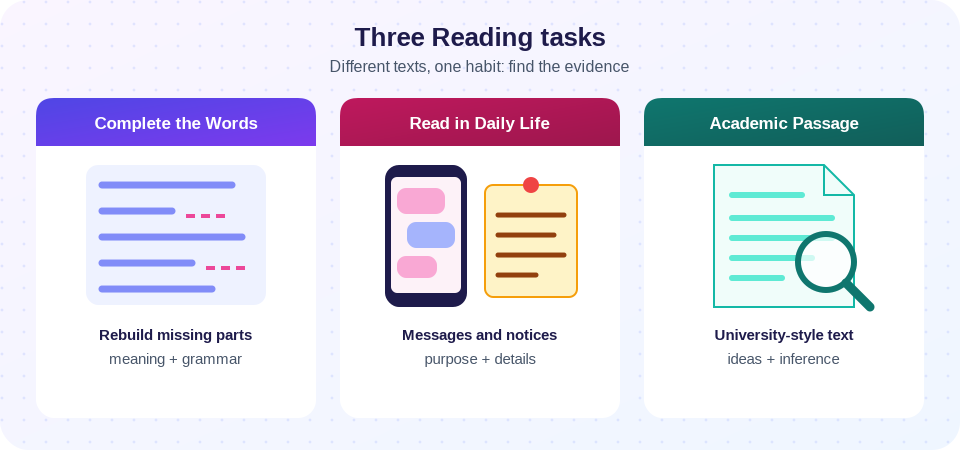
The Reading section comes first. It asks you to do three different things: rebuild words, understand short everyday texts and understand a short academic passage. Each needs a slightly different kind of attention, but all of them reward the same habit: use the evidence on the screen.
What you will learn
- what each of the three tasks asks for
- how the section is built
- a four-step method for comprehension questions
- how to read for different purposes
Three tasks
One method
The section at a glance
ETS lists 50 items for Reading, and the time can vary. The section is adaptive in two stages, and it includes some unscored questions that you cannot identify. The texts stay visible while you answer, according to the ETS test specifications, so you can look back at them. Each correct scored item is worth one raw point.
| Task | Text | Main skills |
|---|---|---|
| Complete the Words | A short text with partly missing words | Vocabulary, grammar, spelling, context |
| Read in Daily Life | Everyday texts such as notices and messages | Purpose, details, implied meaning |
| Read an Academic Passage | A short university-style passage | Main idea, details, inference, vocabulary, organization |
ETS describes the range of texts as running from very short everyday messages, some only a few dozen words or fewer, to academic passages of up to about 200 words. Short does not always mean easy. A short text may pack in several conditions, such as who, when and what if.
Reading with a purpose
You do not read a bus notice the way you read a science passage. Good readers change speed and attention to match the goal.
- Skimming is reading quickly for the general idea. Look at the title, the first sentence and words that repeat.
- Scanning is searching for a specific detail, such as a date, a name or a price.
- Close reading is reading one part slowly to understand its exact meaning, including words such as "only", "unless" and "may".
Many questions use all three: skim to learn the shape of the text, scan to find the right place, then read that place closely.
The evidence-first method
- Ask: put the question in your own words. Does it ask for the purpose, a detail, a meaning or something implied?
- Locate: find the sentence or sentences that answer it.
- Remove: cross out options that the text does not support.
- Choose: compare the survivor with the exact wording of the question.
Worked example
The campus bicycle workshop offers free brake checks on Wednesdays. Students must sign up online before noon on the day of their visit. Repairs that need new parts are not free.
Question: What must a student do to get a brake check on Wednesday?
- Options: A) Sign up online before noon that day. B) Pay for new parts first. C) Visit before noon.
Ask: what is required. Locate: the second sentence. Remove: B is about repairs that need parts, not about the check. C changes the meaning: noon is the limit for signing up, not for visiting. Choose: A.
Where wrong options come from
A wrong option often does one of these things. The names are our own study labels.
| Trap | What it does | Example for the workshop text |
|---|---|---|
| Moved detail | Attaches a true detail to the wrong thing | "Visit before noon" |
| Too strong | Turns a limited claim into "all" or "never" | "All repairs are free" |
| Not mentioned | Adds an idea that sounds likely | "Helmets are checked too" |
| Opposite | Reverses the meaning | "No sign-up is needed" |
When you review a mistake, name the trap. After a week you may find that one trap catches you again and again.
Practice habits between lessons
Read something short in English every day: a notice, a message, a paragraph from an article. After each one, say its purpose in one sentence. This small habit trains the first step of every comprehension question.
Also vary the topics. If you only read about sports, a paragraph about soil or ancient pottery will feel harder than it is. You do not need to become an expert. You need to feel comfortable meeting an unfamiliar subject and letting the text explain it to you.
How this chapter builds
The next four lessons follow a ladder. First you work at the level of single words and sentences. Then you read short everyday texts, where one message and a few conditions carry the meaning. Finally you spend two lessons on academic passages: one on main ideas and details, and one on inference, vocabulary and organization. Even if one task already feels easy, try its practice set once. A comfortable skill can still hide a repeated habit, such as skipping a small limiting word, and the practice is a quick way to find it. Keep your error log open as you go, because the same trap often appears in more than one task.
Common mistakes
- Choosing an option only because it repeats words from the text.
- Using your own knowledge when the text says something narrower.
- Ignoring small words such as "not", "only", "unless" and "before".
- Reading every text at the same speed.
Try it
Choose the reading approach that fits the goal.
Now name the trap in each wrong option. The text is: The art room is open to registered club members on weekday evenings.
Check your understanding
Quick check · 4 questions
of 4 answered You scored / 4 · perfect!
-
1. How many task types does the Reading section have?
Complete the Words, Read in Daily Life and Read an Academic Passage. -
2. What is scanning?
Scanning looks for particular information. -
3. What should support your answer to a comprehension question?
The text is the evidence. -
4. A text says some repairs are free, and an option says all repairs are free. What is the trap?
"Some" is not "all".
Summary
- Reading has three task types.
- Skim for the idea, scan for details, close read for exact meaning.
- Ask, locate, remove, choose.
- Name the trap when you review mistakes.
Next: Complete the Words
Verfolge deinen Fortschritt
Erstelle ein kostenloses Konto, hake Lektionen ab und mach auf jedem Gerät dort weiter, wo du aufgehört hast.