
























Lektion 23 · Body Language and Presence
Posture and Stance
Stand or sit in a steady, comfortable way when you speak. Learn a simple base position, what to do with your feet and hands, and how to adapt it.
Before you say a word, people can see you. The way you stand or sit affects your breathing, your voice and your comfort. It may also affect how ready you seem.
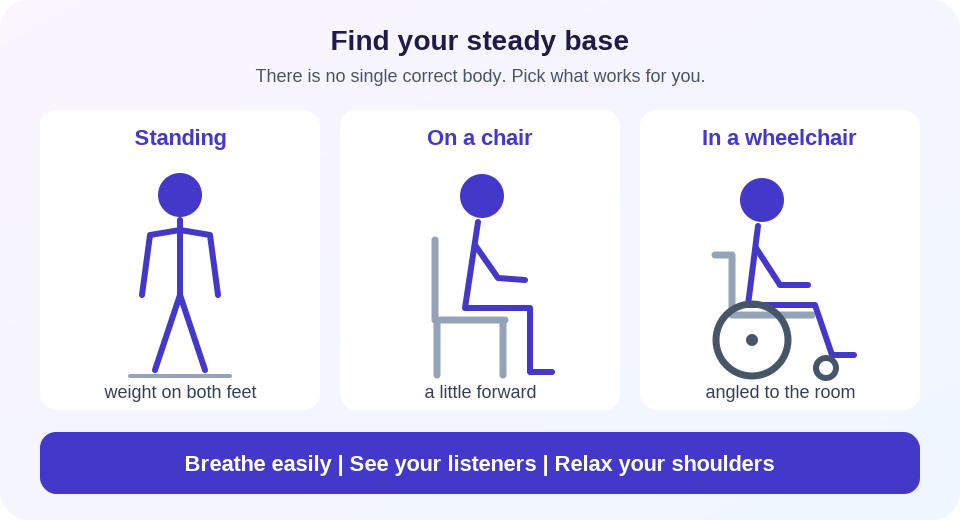
There is no single correct body. Speakers use wheelchairs, canes and chairs. Some stand with pain, some cannot stand for long and some move in their own ways. A good stance is one that lets you breathe, see your listeners and speak with ease.
What you will learn
- How to find a comfortable base position
- What to do with your feet, shoulders and hands
- How to use notes and a lectern
- How to speak well while seated
- How to notice nervous habits
Presence is not a costume
You may read confident claims about what each posture "really means." Be careful. People read body language differently across cultures and situations. Crossed arms might show that someone is cold, comfortable or doubtful. One sign alone rarely tells the whole story.
So treat posture as a practical tool, not a secret code. Ask two questions: Does it help me speak? Does it distract my listeners?
Find your base position
If you stand, try this:
- Place your feet a comfortable distance apart, often about as wide as your hips.
- Let your weight rest on both feet.
- Keep your knees soft, not locked.
- Let your shoulders drop and relax.
- Keep your head level and look toward your listeners.
- Let your arms rest at your sides, or hold your hands loosely in front at waist height.
Take two quiet breaths here. This is your home position. You can move away from it and return to it at any time.
Arms at your sides may feel strange at first. It often looks more natural than it feels. Check with a mirror or a recording.
Seated speaking
You may speak from a chair in a meeting, an interview, a panel or because sitting works best for you.
- Sit in a way that leaves room to breathe, without slumping or straining.
- If it is comfortable, sit a little forward and keep your feet supported.
- Rest your forearms or hands lightly where they are free to gesture.
- Turn your chair or your upper body toward the people you address.
- Check that the table, laptop or microphone does not hide your face.
In a wheelchair, choose a position and angle that let you see the room and be seen. Ask organizers in advance for what you need: a table at a good height, a ramp to the stage, a clip-on or stand microphone or a clear path.
Nervous habits
| Habit | What listeners may notice | Something to try |
|---|---|---|
| Rocking or swaying | A repeated motion | Feel both feet on the floor |
| Pacing without purpose | Restlessness | Stop at one spot for a whole point |
| Weight on one hip, shifting often | Unsteadiness | Return to your home position |
| Clicking a pen | A repeated sound | Put the pen down |
| Gripping the lectern hard | Tension | Rest your fingertips lightly |
| Touching hair or face again and again | A distraction | Give your hands a resting place |
A habit is not a failure. Choose one to work on. Trying to control your whole body at once can make you stiff. Some movements, such as stimming or movements linked to a disability, are part of how a person functions and focuses. They do not need to be "fixed" to give a good talk.
Lecterns and notes
A lectern can hold notes, water and a microphone. It can also hide most of your body, and you may be tempted to lean on it.
- Stand close enough to see your notes, but upright.
- If the microphone is fixed there, stay close enough for it to hear you.
- Use large text so you do not need to bend down.
- Number your pages or cards, so a dropped set is easy to sort.
Without a lectern, hold small cards in one hand. A large loose sheet of paper shows even a slight shake. Cards usually show it less.
Arrive in position
Your talk begins when people first see you at the front. Walk to your spot. Put your notes down. Settle into your home position. Look up and breathe. Then speak. At the end, finish your last line, stay still for a moment and then gather your things. This frames your talk clearly.
A worked example
Farah records herself and sees that she shifts from foot to foot at the start of every section. She chooses this one habit.
At home, she places a small mark on the floor. She begins each section with both feet near the mark and takes one breath. She does not try to stay frozen. After a few practices, she can start sections without watching her feet, and she removes the mark.
Common mistakes
Do not lock your knees or hold a stiff "perfect" pose. Do not try to change every habit at once. Do not copy a posture that causes you pain. Do not judge another person's feelings from one gesture or position. Do not let a table or screen hide your face if you can avoid it.
Try it
Tick each item as you practice your base position.
Check your understanding
Quick check · 4 questions
of 4 answered You scored / 4 · perfect!
-
1. What makes a good speaking stance?
A useful stance supports you and can differ between people. -
2. What does one gesture, such as crossed arms, tell you?
A single sign can have many reasons. -
3. What is a home position?
It gives your body a steady starting point. -
4. You notice five habits in a recording. What is a sensible plan?
Working on one habit is manageable and less likely to make you stiff.
Summary
- Choose a base that helps you breathe and see your listeners.
- Standing and sitting can both work well.
- Do not read too much into single gestures.
- Work on one distracting habit at a time.
- Settle before your first word and after your last.
Next: Gestures and Movement
Verfolge deinen Fortschritt
Erstelle ein kostenloses Konto, hake Lektionen ab und mach auf jedem Gerät dort weiter, wo du aufgehört hast.