
























Lektion 14 · Vital Signs and Assessment
Vital Signs: An Overview
Meet the main vital signs, see commonly taught adult reference ranges, learn why baseline and trends matter, and know when a reading needs to be reported.
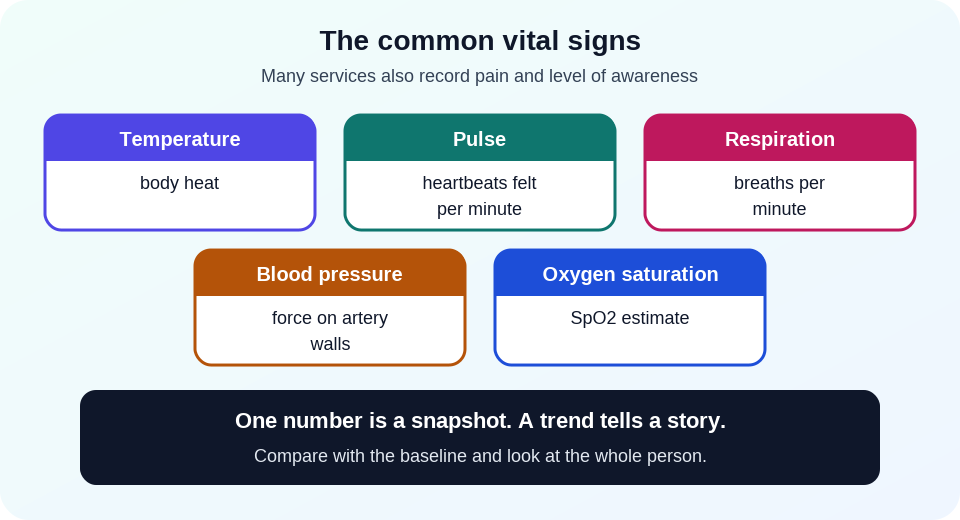
Vital signs are basic measurements that show how the body is working. They help nurses notice change, sometimes before a person looks seriously unwell.
A number by itself tells only part of the story. You need the person, the context and the trend.
This chapter is general education. The ranges below are common textbook figures for adults at rest. They are not targets for any individual and not a guide for decisions. Use the charts, limits and escalation rules of your workplace. If someone seems seriously unwell, call for emergency help.
What you will learn
- The common vital signs
- Commonly taught adult resting ranges
- What can change a reading
- Why baseline and trends matter
- How to report a concern
The main signs
| Vital sign | What it tells you |
|---|---|
| Temperature | Body heat |
| Pulse (heart rate) | Heartbeats per minute felt or counted |
| Respiratory rate | Breaths per minute |
| Blood pressure | Force of blood on artery walls |
| Oxygen saturation (SpO2) | Estimated percentage of hemoglobin carrying oxygen |
Many services also record pain and level of awareness. Some use an early warning score that combines several measurements.
Commonly taught adult ranges
| Sign | Often-quoted resting range |
|---|---|
| Temperature (oral) | About 36.1 to 37.2 °C (97 to 99 °F) |
| Pulse | About 60 to 100 beats per minute |
| Respiratory rate | About 12 to 20 breaths per minute |
| Oxygen saturation | Often about 95% to 100% in healthy people |
Sources and guidelines differ slightly. For example, some quote 12 to 18 breaths per minute, or a slightly different temperature range. Blood pressure categories especially vary between guidelines, so check which one your service uses. A reading below 120/80 mmHg is often described as normal for adults in some guidelines.
Children have different ranges that change with age. Some adults, such as certain athletes or people with some lung conditions, have different usual values or targets set by clinicians.
What can change a reading
- Activity: exercise raises pulse, breathing and blood pressure
- Emotion: stress or fear can raise values
- Pain
- Time of day: temperature usually varies through the day
- Food, drink, caffeine or smoking
- Medicines
- Environment: heat or cold
- Equipment and technique: wrong cuff size, poor sensor contact
When possible and safe, let a person rest quietly before routine measurements.
Baseline and trends
A baseline is what is usual for this person. A trend is how readings move over time.
Look at this fictional pulse record for one resting adult:
| Time | Pulse |
|---|---|
| 08:00 | 72 |
| 12:00 | 84 |
| 16:00 | 96 |
Each number sits inside the often-quoted range of 60 to 100. Yet the steady rise is worth noticing. A good nurse looks for reasons, checks the other signs and the person, and reports according to local rules.
The opposite can also happen. A value outside a common range may be usual for one person. This is why you compare with the baseline and follow the individual care plan.
When a reading is unexpected
A sensible general order is:
- Look at the person first. How do they look? What do they say?
- If they seem very unwell, call for help immediately. Do not delay to double-check.
- If it is safe, check the technique and equipment and repeat the measurement.
- Report the result and your concern to the right person.
- Record accurately, including the time and what you did.
Never change a number to make it look normal. Never record a value you did not measure.
Respect and safety
Explain what you will measure and ask permission. Clean shared equipment according to policy. Notice where you place devices; for example, some arms should not be used for blood pressure. Check the care plan.
A person may breathe differently if they know you are watching. Many nurses count breaths while still appearing to take the pulse.
Early warning scores
Some services add points to vital signs based on how far each one is from a set range. The total helps staff decide how often to check and whom to call. These are often called early warning scores. The ranges, points and actions differ between systems, so never apply one system's numbers in a place that uses another. A low score also does not cancel your concern. Escalation policies often let staff call for help because they are worried, even when the numbers look acceptable.
Reporting a concern clearly
Use the SBAR structure from the last chapter. Include the current readings, the usual baseline, what you see, what the patient says and what you are asking for.
A fictional example: "This is Lee on Ward 2. I'm worried about Ms. Kaya. Her pulse has risen over the last three checks and she says she feels unwell. This is new for her. Please come and assess her."
Afterwards, record the time of the call, who you spoke to and what happened next. If help does not arrive or the person gets worse, escalate again.
Common mistakes
- Treating a textbook range as the right value for every person.
- Looking at one number and ignoring the trend.
- Trusting the machine over how the person looks.
- Estimating or copying values instead of measuring.
- Waiting until the end of the shift to report a worrying change.
Try it
Compare readings with a person's usual pattern. Use the teaching rule shown. This rule is invented for practice only.
Check your understanding
Quick check · 4 questions
of 4 answered You scored / 4 · perfect!
-
1. What is a baseline?
Readings are compared with the person's usual values. -
2. A resting pulse goes 70, 82, 95 over some hours. What is the best response?
A trend can matter even inside a commonly quoted range. -
3. A patient looks very unwell and the reading is alarming. What comes first?
Do not delay urgent help to recheck. -
4. Which can change a vital sign reading?
Many factors affect results, so note the context.
Summary
- The common vital signs are temperature, pulse, respiration, blood pressure and oxygen saturation.
- Textbook ranges vary and are not individual targets.
- Compare with the baseline and watch trends.
- Look at the person, get help when needed, and record honestly.
Next: Temperature and Pulse
Verfolge deinen Fortschritt
Erstelle ein kostenloses Konto, hake Lektionen ab und mach auf jedem Gerät dort weiter, wo du aufgehört hast.