
























Lektion 35 · Practice and Review
Building a Practice Routine
Plan short, focused guitar practice sessions with warm-ups, technique, new material and songs, then set clear goals and track your progress.
Regular practice usually helps more than rare, long sessions. A short routine that you can keep is better than a perfect plan you avoid. This lesson helps you design a session that fits your life.
What you will learn
- The four parts of a balanced session
- How to set small, clear goals
- How to track progress
- How to stay healthy and motivated
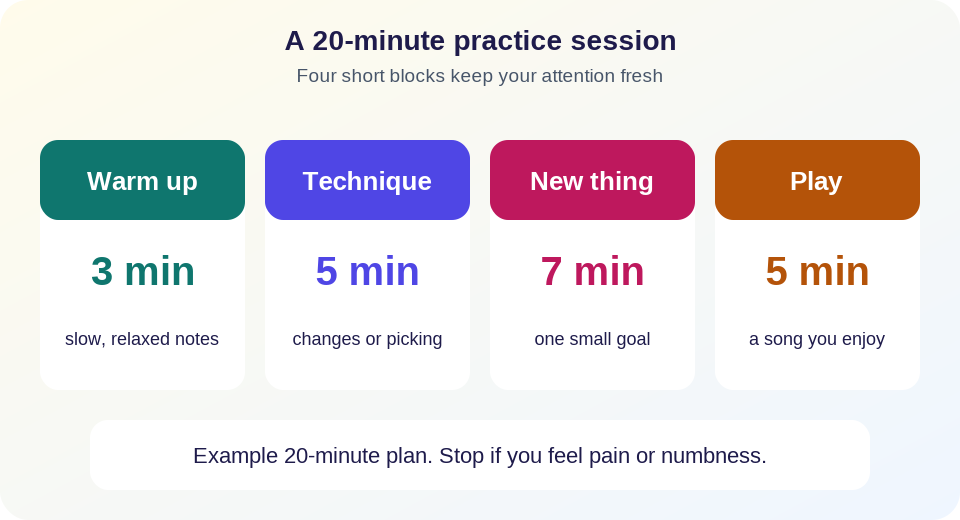
Four blocks
Here is one example for 20 minutes. Change the times to suit you.
- Warm up (3 minutes). Check your tuning. Play slow single notes or easy chords. Keep your hands relaxed.
- Technique (5 minutes). Work on chord changes or alternate picking.
- New thing (7 minutes). Learn one small thing, such as a new shape or two bars of a song.
- Play (5 minutes). Play something you enjoy from start to finish.
If you only have ten minutes, do shorter versions. Even five focused minutes can keep your skills active.
Set goals you can check
"Get better at guitar" is hard to measure. A clear goal says what, how fast and how well.
| Vague goal | Clear goal |
|---|---|
| Learn chords | Change between C and G ten times without a dead string |
| Play faster | Play the open-string drill cleanly at 80 beats per minute |
| Learn a song | Play the chorus three times without stopping |
When you reach a goal, choose the next small step.
The one-minute change test
Choose two chords. Set a timer for one minute. Count how many clean changes you can make. Write down the number. Repeat on another day. The trend shows your progress better than memory. Do not sacrifice a relaxed hand to get a higher count.
Slow practice
When something is hard, slow it down until you can play it correctly. Your hands tend to learn what you repeat, including mistakes. Raise the speed in small steps.
Spread it out
Several short sessions across the week usually help you remember skills better than one long block. Try to return to a hard skill on different days. Sleep and rest also help learning.
A practice log
A notebook works well. Record the date, what you practiced, one thing that went well and one thing to fix next time. This takes less than a minute and stops you from repeating the same easy material only.
Date: Tuesday
Worked on: C to G changes, verse of my song
Went well: G is now clean
Next time: Keep finger 3 close during the change
A worked example: a weekly plan
| Day | Focus |
|---|---|
| Monday | Chord changes and a song chorus |
| Tuesday | Picking drills |
| Wednesday | Rest or play for fun |
| Thursday | Fretboard notes and a scale |
| Friday | Song verse and joins |
| Weekend | Play through your song list |
Rest days are fine. Return to the plan without guilt after a break.
Staying healthy
- Take short breaks, for example every 20 to 30 minutes in longer sessions.
- Relax your shoulders, wrists and thumbs.
- Stop if you feel pain, tingling or numbness. Get professional advice if it continues.
- Keep amplifier and headphone volume at a safe, comfortable level, and protect your ears in loud places.
Keeping motivation
Keep one song you love in your routine. Record yourself once a month and compare old and new clips. Progress is often slow day by day, but clear over months.
Leave your guitar in a safe, easy-to-reach place. Picking it up becomes much easier when it is ready.
Planning around your life
Pick a time that already has a habit around it, such as after dinner. Linking practice to something you already do can make it easier to remember. Decide the first small action, for example "take the guitar out and tune it". Starting is often the hardest part.
Dealing with a plateau
Sometimes it feels as if nothing improves for a while. This is common in learning. Try one of these ideas.
- Lower the tempo and focus on clean sound.
- Change the exercise, but keep the same skill.
- Take a rest day, then try again.
- Compare today's recording with one from a month ago.
Reviewing old material
New material is exciting, but old skills get rusty if you never use them. Once or twice a week, replay a song or chord change you learned earlier. This quick review often takes just a few minutes and keeps your list of playable songs growing instead of shrinking.
Using a timer
A simple timer stops you from spending the whole session on your favorite block. When it rings, move on, even if you want to continue. You can come back to it tomorrow.
Ending the session well
Finish with something that sounds good to you, even if it is only two chords played slowly. Then spend a moment on your log. Write the next small step while it is fresh in your mind. When you sit down again, you will know exactly where to begin, and you will not waste the first minutes deciding.
Put the guitar away safely, in its case or on a stable stand, away from heat and damp.
Common mistakes
- Practicing only what you already play well.
- Setting goals too big to finish in a week or two.
- Pushing through pain or ringing ears.
- Never checking tuning before practice.
Try it
Enter your total time. The planner splits it into four blocks in the same proportions as the example.
Check your understanding
Quick check · 4 questions
of 4 answered You scored / 4 · perfect!
-
1. Which goal is easiest to check?
It states an exact task and result. -
2. What should you do when a part is hard?
Correct slow repetitions build good habits. -
3. What is a useful note for a practice log?
It gives your next session a clear starting point. -
4. What should you do if you feel numbness while practicing?
Numbness is a warning sign. Get advice if it continues.
Summary
- A balanced session has a warm up, technique, new material and play.
- Set small goals that you can check.
- Practice slowly and spread sessions across the week.
- Keep a short log.
- Protect your hands and hearing.
Next: Fixing Common Problems
Verfolge deinen Fortschritt
Erstelle ein kostenloses Konto, hake Lektionen ab und mach auf jedem Gerät dort weiter, wo du aufgehört hast.