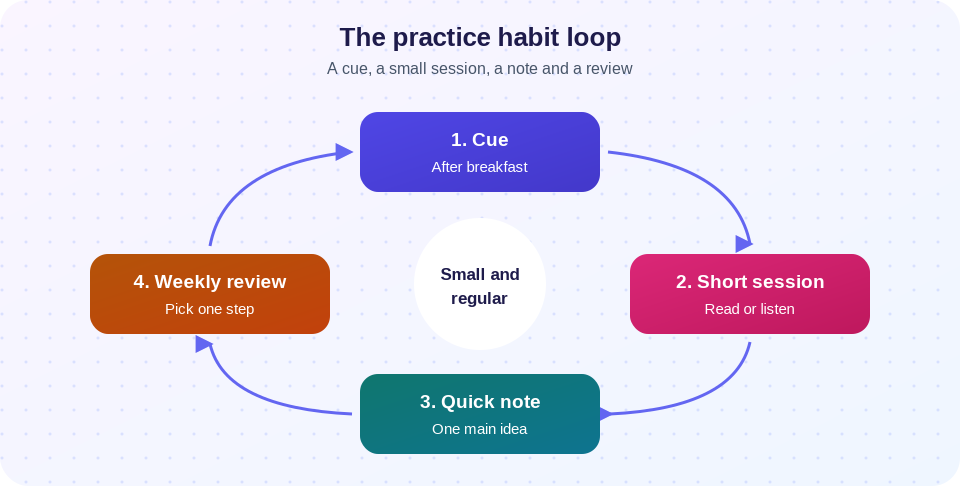
Design a small, realistic daily habit for English listening and reading with a cue, a routine, a fallback plan and weekly review.
Strategies help only when you use them often. Understanding grows from many meetings with English over weeks and months. A short routine that you actually keep is usually more useful than a long plan that you give up after a few days.
This chapter helps you build that routine: choose a time, choose material, and look back at what you learned.
A habit is a loop: a cue starts a small session, and a quick review keeps it useful.
Read or listen to a lot of easy, enjoyable material
Builds speed, comfort and meetings with common words
Intensive
Study a short text or clip closely
Builds accuracy and shows you what you miss
You need both. Many learners spend all their time on hard study and find it tiring. Others only enjoy easy material and never look closely at their problems. A good week mixes the two, often with more easy time than hard time.
Prepare the material before the cue arrives. Save a few articles, or keep a book where you sit. If you listen on the way somewhere, download or queue the audio while you have a connection, if your service allows it. Keep your headphones in the same place. Removing small obstacles matters more than a burst of motivation.
On busy days, do the tiny version: read one paragraph or listen to one minute. It keeps the link between the cue and the action. If you want to continue, great. If not, you still did what you planned.
Missed days happen. Do not try to repay them with a giant session. Restart with the minimum version at the next cue. If you often miss the same slot, the plan, not your character, probably needs a change: pick another time or an easier task.
The planner below turns your choices into a short list you can copy to paper or a notes app. The preview cannot save anything, so keep your plan somewhere you will see it.
Build your weekly habit plan
<style>body{font-family:system-ui,sans-serif;margin:0;padding:12px;background:#faf5ff;color:#1e1b4b;line-height:1.5}.card{background:#fff;border:1px solid #e0e7ff;border-radius:14px;padding:12px 14px;margin:0 0 10px;box-shadow:0 4px 12px rgba(99,102,241,.1)}button{font:inherit;cursor:pointer;border:1px solid #a5b4fc;background:#eef2ff;color:#1e1b4b;border-radius:999px;padding:6px 14px;margin:4px 6px 0 0}button.go{background:#4f46e5;color:#fff;border-color:#4f46e5}button.ok{background:#d1fae5;border-color:#059669}button.no{background:#fee2e2;border-color:#dc2626}button:disabled{cursor:default}input,select,textarea{font:inherit;padding:5px 8px;border:1px solid #a5b4fc;border-radius:8px;max-width:100%;box-sizing:border-box}.fb{margin-top:6px;font-size:14px;color:#334155}p{margin:6px 0}</style><divclass="card"><p><label>After I... <inputid="cue"value="make my morning drink"size="30"></label></p><p><label>Minutes on a normal day <inputid="mins"type="number"min="1"max="120"value="15"style="width:90px"></label></p><p><label>Minimum on a busy day (minutes) <inputid="min"type="number"min="1"max="30"value="2"style="width:90px"></label></p><p><label>Practice days per week <inputid="days"type="number"min="1"max="7"value="5"style="width:90px"></label></p><buttonclass="go"id="make">Make my plan</button></div><divclass="card"id="out">Your plan will appear here.</div><script>const kinds =['Easy reading','Study one short listening clip','Easy listening','Close read one short text','Review saved words','Free choice reading','Free choice listening'];functionclamp(value, low, high){return Math.min(high, Math.max(low, Math.round(Number(value)|| low)));}
document.getElementById('make').onclick=function(){const out = document.getElementById('out');const days =clamp(document.getElementById('days').value,1,7);const mins =clamp(document.getElementById('mins').value,1,120);const min =clamp(document.getElementById('min').value,1,30);
out.textContent ='';const lines =['Cue: After I '+ document.getElementById('cue').value.trim()+', I will practice English.'];for(let i =0; i < days; i++){
lines.push('Session '+(i +1)+': '+ kinds[i]+' ('+ mins +' minutes)');}
lines.push('Busy day version: '+ min +' minutes.');
lines.push('Planned total: '+(days * mins)+' minutes per week.');
lines.forEach(function(line){const p = document.createElement('p');
p.textContent = line;
out.appendChild(p);});};</script>
Pick topics you would read or watch in your own language. Interest keeps you going when the language is hard. Some learners enjoy a partner: you each read the same short text and tell each other one thing you noticed.
A session goes better when you know what it is for. "Read for pleasure" is a fine aim. So is "listen once for the main idea" or "notice how the speaker changes topic". One aim is enough. If you try to learn new words, copy the accent, take notes and enjoy the story all at once, you may feel that you failed at all of them.
Say the aim before you begin, and check it when you finish. A one-line answer is enough: "I followed the main idea, but I lost the part about prices." That line tells you where to start next time. It also lets you finish with a clear sense of what you did, which makes it easier to come back tomorrow.
Turn off notifications for the length of your session if you can. A short stretch of full attention teaches you more than a long one broken by messages. Background audio can still be pleasant, but count it as extra, not as your practice session.
<style>body{font-family:system-ui,sans-serif;margin:0;padding:12px;background:#faf5ff;color:#1e1b4b;line-height:1.5}.card{background:#fff;border:1px solid #e0e7ff;border-radius:14px;padding:12px 14px;margin:0 0 10px;box-shadow:0 4px 12px rgba(99,102,241,.1)}button{font:inherit;cursor:pointer;border:1px solid #a5b4fc;background:#eef2ff;color:#1e1b4b;border-radius:999px;padding:6px 14px;margin:4px 6px 0 0}button.go{background:#4f46e5;color:#fff;border-color:#4f46e5}button.ok{background:#d1fae5;border-color:#059669}button.no{background:#fee2e2;border-color:#dc2626}button:disabled{cursor:default}input,select,textarea{font:inherit;padding:5px 8px;border:1px solid #a5b4fc;border-radius:8px;max-width:100%;box-sizing:border-box}.fb{margin-top:6px;font-size:14px;color:#334155}p{margin:6px 0}</style><divid="app"></div><script>const intro =[];const items =[{"q":"Which plan has a clear cue?","options":["After I brush my teeth, I will read one page","I will read more English this year","I will practice sometime"],"answer":0,"why":"It names when and what."},{"q":"Which is a useful busy-day version?","options":["Study for three hours","Listen to one minute of a clip","Skip every day until the weekend"],"answer":1,"why":"A tiny version keeps the habit alive."},{"q":"You missed four days. What is best?","options":["Study for eight hours tonight","Give up the plan forever","Restart small at the next cue"],"answer":2,"why":"A gentle restart is easier to keep."}];functionel(tag, text, parent, cls){const node = document.createElement(tag);if(text){ node.textContent = text;}if(cls){ node.className = cls;}(parent || document.getElementById('app')).appendChild(node);return node;}functionbuildQuestions(parent){let right =0;let done =0;const total = document.createElement('p');
items.forEach(function(item, n){const card =el('div','', parent,'card');el('p',(n +1)+'. '+ item.q, card);const feedback = document.createElement('div');
feedback.className ='fb';const buttons = item.options.map(function(label, i){const button =el('button', label, card);
button.onclick=function(){
buttons.forEach(function(b){ b.disabled =true;});
buttons[item.answer].className ='ok';if(i === item.answer){ right++;}else{ button.className ='no';}
done++;
feedback.textContent =(i === item.answer ?'Correct. ':'Not this one. ')+ item.why;
total.textContent ='Your count: '+ right +' correct out of '+ done +' answered.';};return button;});
card.appendChild(feedback);});
parent.appendChild(total);}if(intro.length){const box =el('div','',null,'card');
intro.forEach(function(line){el('p', line, box);});}buildQuestions(document.getElementById('app'));</script>