
























Lektion 19 · Nonverbal Communication
Nonverbal Communication: An Overview
Learn the main nonverbal channels, from face and eyes to posture, gestures, space and voice, and how to read signals carefully without guessing too much.
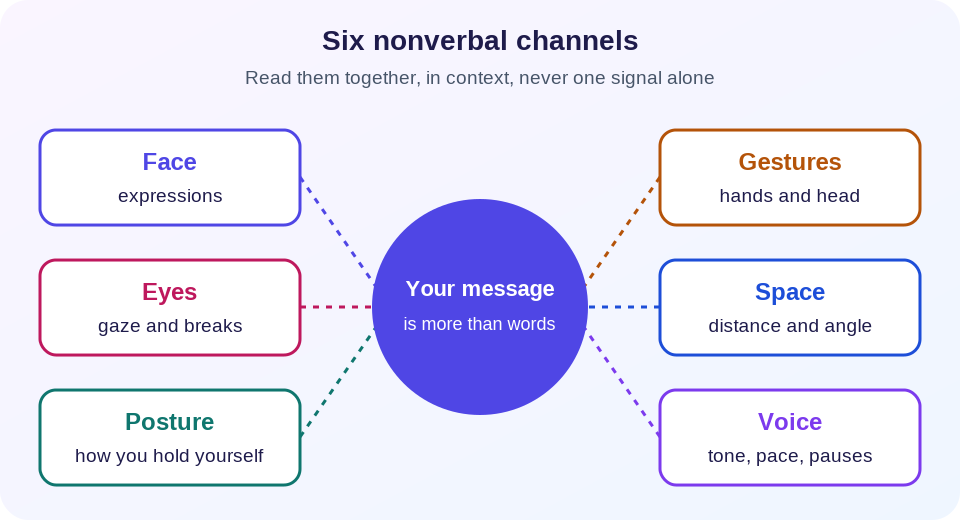
When you talk with someone, your words are only part of the message. Your face, your posture, your distance and your voice also say something. These are nonverbal signals. People notice them quickly, often without thinking about it.
Nonverbal signals can support your words, soften them or work against them. If you say "I am happy to help" while you look at your phone and sigh, many listeners will believe the sigh. In this lesson you will learn the main channels and a safe way to read them.
What you will learn
- The main channels of nonverbal communication
- What happens when words and signals do not match
- Why one signal alone tells you very little
- A three-step method for reading signals politely
The six channels
| Channel | Examples | What it can suggest |
|---|---|---|
| Face | smile, raised eyebrows, tight lips | interest, surprise, worry |
| Eyes | looking at you, looking away | attention, thinking, discomfort |
| Posture | leaning in, slumping, turning away | energy, tiredness, interest |
| Gestures | nodding, pointing, open hands | agreement, emphasis |
| Space | standing close, stepping back | comfort, closeness, formality |
| Voice | tone, speed, volume, pauses | confidence, stress, care |
Notice the phrase "can suggest." No signal has one fixed meaning. Crossed arms can show disagreement. They can also mean that the room is cold, that the chair has no armrests or that this is simply a comfortable position.
When words and signals disagree
A mismatch happens when your words say one thing and your signals say another.
- Words: "That is a great idea." Signals: a flat voice and no eye contact.
- Words: "I have plenty of time." Signals: checking the clock again and again.
- Words: "I am not upset." Signals: short answers and a tight jaw.
Mismatches confuse people. When you notice one in yourself, you have two honest choices. You can change your behavior so it fits your words. Or you can change your words so they fit what is going on: "I do have to leave in ten minutes, but I want to hear this."
Why context matters
Before you decide what a signal means, think about four things.
- The setting. Quiet behavior in a library or a formal meeting is normal.
- The person's usual habits. Some people rarely smile, even when they are content.
- Health and ability. Pain, tiredness, disability or neurodivergence can change eye contact, movement and facial expression.
- Culture. Gestures, eye contact and personal space follow different customs in different places and families.
A change from a person's usual behavior is often more useful than a single signal. If a talkative colleague suddenly goes silent, that is worth noticing. It still does not tell you why.
Be careful with claims that one gesture proves someone is lying or hiding something. People show stress and honesty in many different ways. Do not use body language as a lie detector.
Read signals in three steps
- Notice what you can actually see or hear: "She has not said anything for ten minutes."
- Consider several explanations: she is thinking, she is tired, she disagrees, or she has other worries.
- Check with a kind, open question: "You have been quiet. Is there anything you would like to add?"
Here is a worked example. During a training session, your trainee frowns at the screen.
- Weak response: "Don't worry, it is easy." (You guessed that he is worried.)
- Better response: "I see you looking closely at this step. What is on your mind?"
He might say, "The font is so small that I can't read it." Your guess would have been wrong, and the question saved time.
Send clearer signals yourself
You cannot control every movement, and you do not need to. Aim for a few simple habits.
- Put your phone out of sight when a conversation matters.
- Turn your body toward the speaker, if that is comfortable for you.
- Let your face and voice fit the topic. Calm and serious is fine for bad news.
- Say what is going on when your signals could mislead: "I am looking down because I am taking notes."
The last habit is very useful. A short explanation removes a lot of guessing.
Practice your noticing
You can train this skill in everyday life. Pick a calm, ordinary conversation with someone who knows you well. Afterward, write down two things you saw or heard, using plain facts. For each one, write at least two possible reasons.
For example: "My brother tapped the table." Possible reasons: he was thinking about a song, or he wanted to leave. You do not need to find out which is true unless it matters. The point is to build the habit of holding more than one explanation.
You can also review your own signals. Ask a trusted friend, "Is there anything I do while listening that makes it hard to talk to me?" Listen to the answer without arguing. You may learn about a habit you never noticed, such as looking at the door or finishing other people's sentences.
Do this gently. Watching every tiny movement can make you and others uncomfortable. Your main job in a conversation is still to listen to what the person says.
Common mistakes
- Reading one gesture as a clear fact about someone's feelings
- Forgetting that habits differ between people and cultures
- Judging someone for avoiding eye contact
- Acting a "perfect" posture so hard that you stop listening
Try it
Choose whether each sentence is an observation (something you can see or hear) or a guess.
Check your understanding
Quick check · 4 questions
of 4 answered You scored / 4 · perfect!
-
1. A coworker has crossed arms during your talk. What is the best conclusion?
Crossed arms have many possible causes, such as comfort or a cold room. -
2. What is a mismatch?
A mismatch means your words say one thing and your signals suggest another. -
3. What should you do after you notice a signal and think of possible reasons?
Checking replaces guessing with real information. -
4. Which is often more useful than a single signal?
A change can be worth noticing, although it does not explain the reason.
Summary
- Nonverbal signals include face, eyes, posture, gestures, space and voice.
- Mismatches between words and signals confuse listeners.
- Context, habits, health, ability and culture all shape behavior.
- Notice, consider several explanations, then check.
Verfolge deinen Fortschritt
Erstelle ein kostenloses Konto, hake Lektionen ab und mach auf jedem Gerät dort weiter, wo du aufgehört hast.